Notes of a Hermetic Conversation between Phillip and Joel on August 22, 2023.

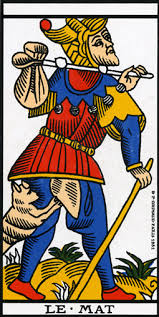
Notice how the ball of the baton touches his hat. It resonates with the hat of the Fool. It’s unusual to cover over the hat/crown like this. In the Fool, the red ball comes at the terminus of the yellow; here, it is the opposite.
The tiny white ball on the top of the blue throne on his other side—this is in contrast to his baton. Is that actually part of his throne? Or another baton?
Is he even sitting on a throne? What is that anyway?
If it’s a throne, which way is it facing? It’s assymetrical if it’s facing forward. But if it’s in profile (seat projecting out from the right side of the card to the left), then hypothetically, there is another parallel pillar to the one we can see that is hidden behind it.
Or maybe he has grabbed the other pillar, now it’s his baton? He’s taking the throne apart—similar to the King of Swords, pulling a baton out of the throne.

Instead of preparing to metamorphose into something else, into the next Arcanum, the King of Batons is dismantling the metamorphic scene, closing up shop.
All the other Court Arcana have a metamorphosis of one kind or another happening, especially the Queen of Swords, such an expression of giving birth and of death. They metamorphose into the next aspect, or there is some part of nature becoming grand forms and taking over, as in the Knight of Swords.

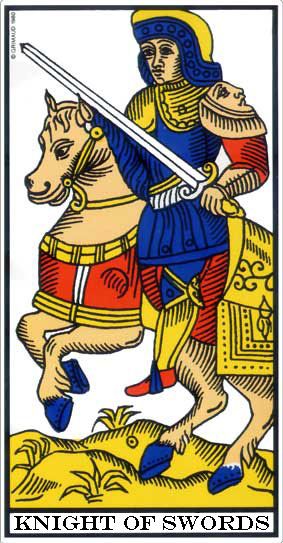
Here, with the King of Batons, there’s a transformation in terms of there being am implement that is extractable, that can be made use of. A finished product that maybe once was part of the throne. The King of Swords allows a little preview of what is coming.
The World as the total synthesis. When she is analyzed we achieve the Minors.


The Minors are the path of analysis. This path culminates in the King, where it is all finally taken apart. This leads to the Magician, who has all these little physical pieces before him. Like taking apart the car’s engine, cleaning each part. Then comes the path of synthesis (the Majors).
Is the King of Batons holding something in his left hand? Holding the breastplate? Why is it over his stomach? Or is it more like a shield? It certainly seems that way if he’s holding onto it. Is it also being removed, set on the table?
He’s transforming the throne into the table. Taking off his armor, setting it out. The fruit of the process of the Minor Arcana.
The Armor of God. He’s more knightly than kingly in that sense.
What are those piano keys over his knees? There are some very artistic, playful designs here. The most ornate, harmonious depiction…but not all harmonious. The designs on his garb are kind of crazy, e.g. the zigzags at his collar. That piano is like a Dali painting, melting piano.
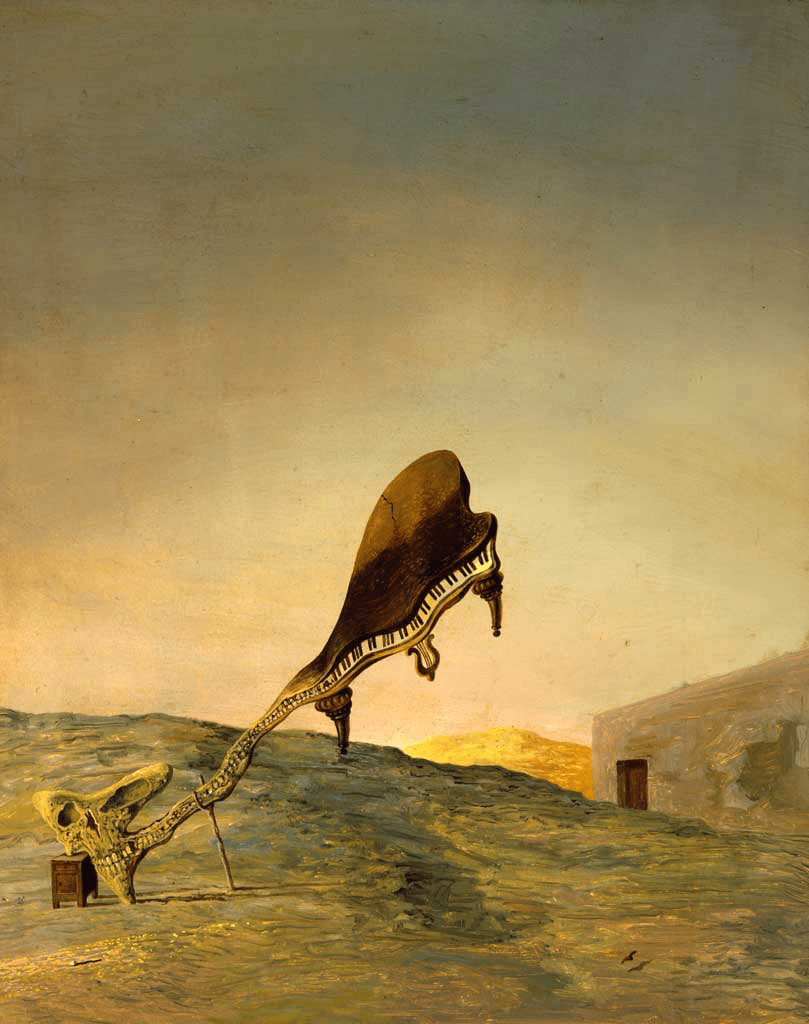
The melting piano form resonates somehow with the yellow fringe on his left shoulder, although quite different.
His knees are so striking. The armor that flaps over his boots. Those are some serious triangular shapes.
Did people actually dress like this? Are those pants? Many have them. Shakespearean?
The horizontal lines to his right (curvy shape) and between his legs. They seem to be referring to each other, but they aren’t quite parallel or the same color.
Is he holding something under his arm left arm? That stripey area. Also seems related/unrelated to the horizontal stripes.
The blue fringe under his right arm is like a call back to the Knave of Cups, the bird-cup.
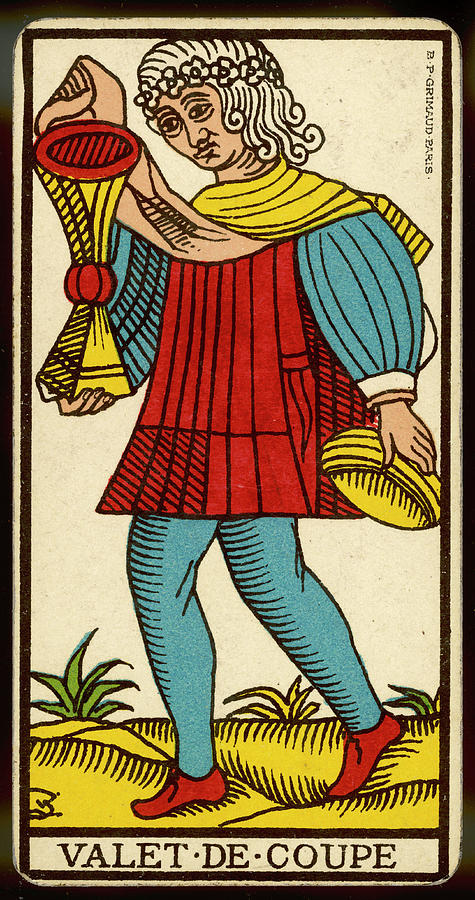
It’s more naturally integrated in the King of Batons vs the Knave of Cups. Doesn’t replace a body part.
It seems like on the left side of the figures in the Court Arcana (our right), there’s something strange going on, and often the object in question (Coin, Sword, Cup, Baton) is on the right side of the figure (left from our perspective).
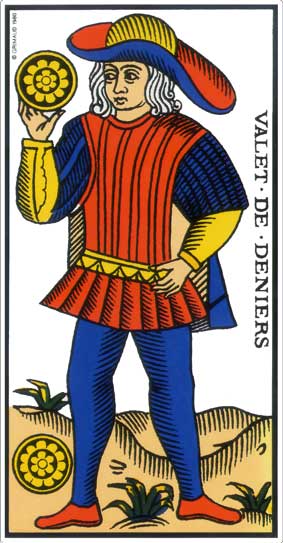
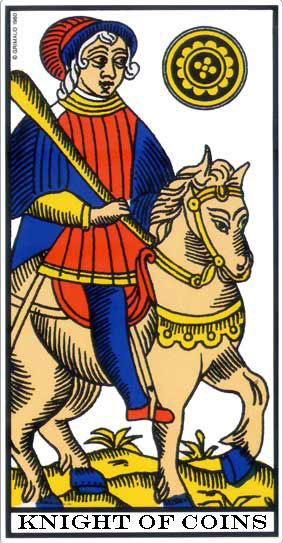
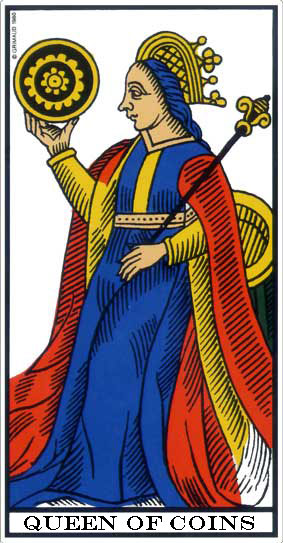
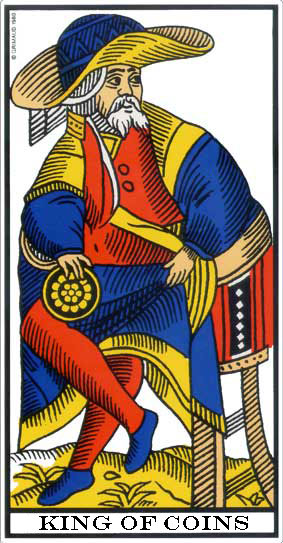
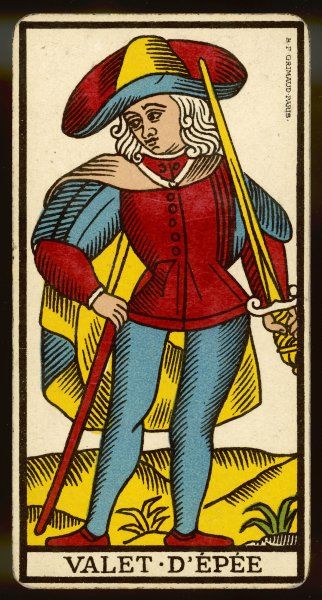


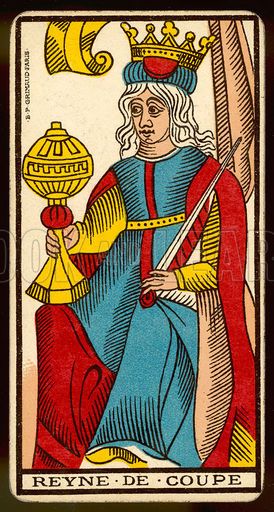
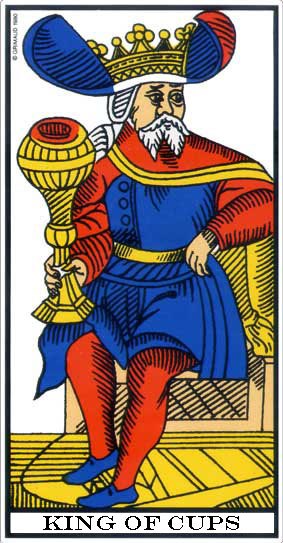

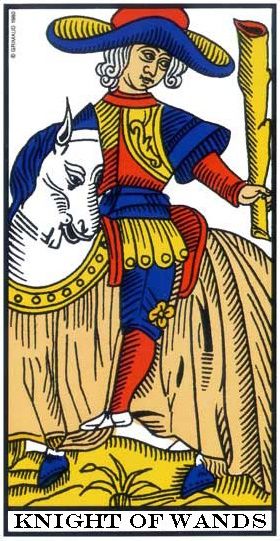
Particularly from the Queen of Swords through the King of Cups, the object is on the figure’s right side. With the Knight of Batons, instead of the object on his right, it’s the arm-horse. This ambiguity, metamorphic element.
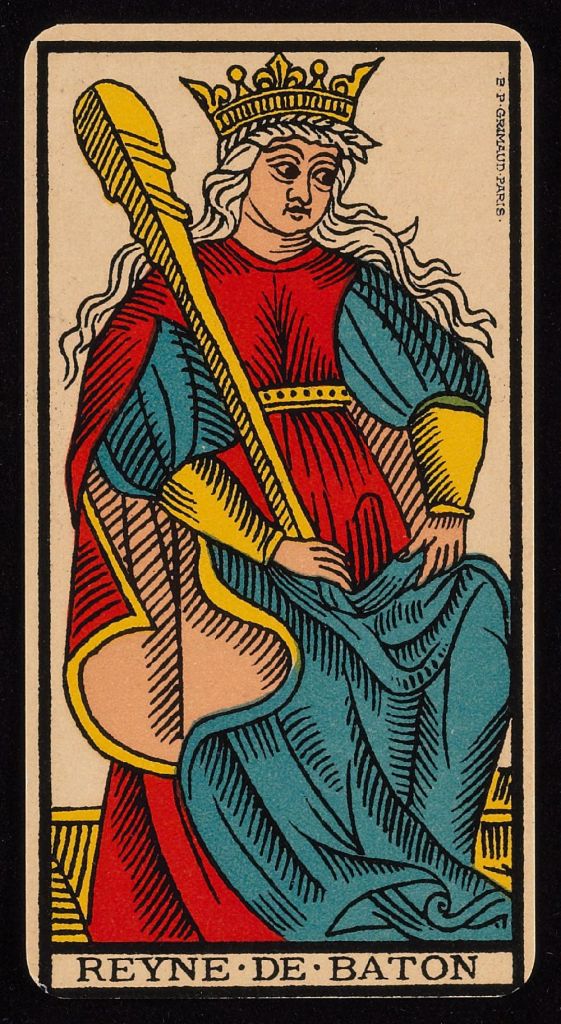
The ambiguous, metamorphic element in the Queen of Batons is the blue garb. It operates below the level of purposeful expression of a specific thing. But it’s clearly expressing something. Pure aesthetic quality with no rational purpose, purely feminine.
Knitting needle with blanket…beating the rug with a broom…
The two—the baton and the “rug”—are very related, but not what we would usually put together (wood with water or fabric?). An operation of some kind is taking place.
The King of Batons has the most noble face of all the cards (we can say this without the usually qualifier of “so far”!)
He looks very young, but not incapable or inexperienced. On the contrary!
The King of Swords also looks young, but not as capable. Chubby cheeks, not work-worn. The King of Swords looks a bit off-balance, vs this multivalent pose of the King of Batons. Like he’s about to leap. Or like he’s just landed, sitting with his knee up, leaning forward with great interest.
Very spry despite huge baton and heavy armor. A lot of balance amidst motion, coordination.
Well-coordinated and looks impossible.
Going back to the yellow ball. Holding it up against his head, extracting something. In the Harry Potter series, there is this device called a pensieve. The characters extract memories using their wands, extracting them from the sides of their heads. The memories get placed in a kind of fluid in a basin. One is able to think more clearly, 1) by being able to observe memories more objectively, like the “etheric review” and/or 2) by having less clutter of the past on their minds. Perhaps he is engaged in such a process.
The yellow ball is also reminiscent of the “Eureka!” light bulb, the brilliant idea or solution.
It seems important that the end of the baton is right up against his calf, about to jab his Achilles’ heel.
Is he grabbing a yellow ball, with his left hand, on the shield/breast plate? Notice that the fifth of those dots is covered by his hand, four of them exposed. A kind of foreshadowing of the Magician, who holds a yellow ball at a similar place with his right hand.
It’s a foreshadowing of the Magician, but the King of Batons already has the ball integrated into the wand. Prefigures the whole process of assembling the scepter from Magician through Empress/Emperor.
Does the yellow ball at the top of the King’s baton belong on the shield? Did he take it off of there and put it on the baton?
The blue pillar, with the white ball at the pinnacle. We are back to the “pearl of great price”, the white stone of the “I.” The pearl is now complete. A little out of place? It’s never been in the Court Arcana before. It was last seen in the Five of Batons, as “eyes.” Two pearls, they got “sucked in” to the growing center.

Now the pearl becomes the pinnacle of something, for the first and only time. Before, it was almost always in the center of the image. Now it is both at the top, and to one side (his left). He seems to be looking right at it. It’s at the peak of this white slope emerging from his shoulder. Hearkens back to the start of the Court Arcana, to the Knave of Coins.
Quite a bit of resonance between these two. The Knave touches his belt similarly to the King touching the breastplate/shield. The knife in the Knave’s sleeve is like a primitive baton, and the coin he holds is like the ball. It was all there in the beginning.
But they are looking in different directions. The Knave is looking at what is still becoming. The King looks at what is.
But the King also has an eye towards…some kind of progression?
We can do Knave and King, as above, looking away from each other. Or:
Like the Knave is about to put the coin into the slope/slot of the King’s throne. “Insert Coin Here to begin.” The King is the process that changes the coin-knife into a full Baton.
The Knave is the past. When we got to the Knave in the Suit of Coins, we saw him as looking back on the previous ten Numbered Coin, the collected wisdom of the past, collected experiences. Reflecting, ruminating, concentrating. The King of Batons is looking to the future, to what will be.
Das Wort. The Coins are the analysis of the primal Logos. The dividing up of The Word into the heirarchies, into language, an ever-more dead language. The King is the renewal of the Logos.
The Logos falls apart into heirarchies, coins. The King is the Logos.
His pen point could be in the background, touching the floor (rather than aiming toward his heel). Touching directly into the center of the floor. Baton starts on the side above, heads to the center below.
The lower portion of the image is mysterious. Is it a trap door?
It’s so much less symmetrical than you think when you first look at it.
The trap door area is quite reminiscent of the mysterious bottom portions of the Ace and Two of Cups:


The King of Batons has all of these strange, unobstrusive call-backs to prior Arcana. They aren’t immediately apparent, but so strong once they are noticed.
Nothing needs to be said about this image.
A mystery expressing another mystery.
We are still like four year olds, not yet able to read, maybe able to recognize certain letters of the alphabet. And so proud of themselves when they do! “I know that letter!” That’s still where we are.
The fish form of the Two of Cups bears some relation to his baton and hat. The intensity. And then this window at the base of the Ace of Cups, similar to this opening, this trap door at the base of his throne. But now the opening is rectangular (akin to the background of the Ace of Cups) and the triangular form of the Ace’s opening is given over to the “pen” tip of the King’s baton. There is something of the pattern of the Ace of Cup’s base in the Kings clothes. The triangles, zigzags.
The designation of a Suit is irrelevant in this case: he represents all Suits. It’s not a club or a baton that he’s holding, it’s something new completely.
He is his own Suit.
He introduces us to the Majors, where each image is its own Suit.
He is analyzed, yet collected and cohesive vs prior Minors.
He is the accumulation, not the synthesis. He’s got the whole collection.
An individual Major is not an accumulation of a bunch of Minors, yet has a formal relationship to them. On the other hand, he can’t be confused with a Major Arcana, he is of the Minors.
He’s of them, their accumulation, yet he stands alone.
He’s like all the other Minors, but none of them are like him. He is beyond compare.

Resonances between The Chariot and the King of Batons. Is the Chariot also an accumulation and/or prefiguring of the other Majors?
Both the Chariot and the King have a strong vertical relationship.
The baton of the Charioteer is the reverse of the King’s pen-staff.
The King of Batons’ implement is like a geometric compass. He creates a circumference around himself. His orientation is downward. The Chariot is oriented above.
Does the other pillar to do with this rotation of the compass?
The curves on the throne, like it’s a smearing of our vision, due to fast rotation.
Those curves are similar to those on Justice’s throne.

We never thought of her in relation to the “pearl of great price.” We didn’t know about them back then.
(“I know that letter!”)
A very special pearl on her forehead. Very well drawn, a perfect pearl.
(We now have such a mess of cards all over the table!)
He’s got his head above the pillar, unlike Justice. He can look at the pearl, or even look over it.
Different than blind Justice. He has the whole overview.
No question that it’s related to a writing object. Carving in clay? Maybe the Knave of Coins was hiding a feather quill up his sleeve, not a dagger. And even a compass is a kind of writing object.
The question of proportions is weird. Is that the pen of a god? Or is he very small?
Weilding the pen of God. The pen is mightier than the Sword. Writing the word of God?
A creative process that gives rise to something—part of which is the thing that can give rise to something similar to that thing, in a similar fashion.
A very tight summary of God’s creative process.
Everything converges to allow the pen to come about, unconsciously.
Paradoxically, the pen is what allows those things to come about.
(Playing with the idea that the pen, which manifests last, is also the pen which is used to draw the the whole series of 78 images from the very beginning. So the drawings need the pen, and the pen needs the drawings, to exist).
The conscious generation of things which will generate something conscious unconsciously.
Back to the Queen of Batons, where the wooden object is the consciousness, stirring the blue, unconscious will-substance.

If the Magician is he who follows on from all of this, we can certainly say he is no charlatan! He may only be a charlatan inasmuch as he is pretending to be much less than he actually is. The master guitarist plays a ukelele.
“Let me (higher being) make this relatable to you (lower being).”
And the Word became flesh and pitched his tent among us.
Maybe the King is trying to set up his tent? Center pole.
Back to the Knave vs King…it’s like a movement from the “blue Moon” pillar of the King to the “full Sun” of the “pillar” of the Knaves right arm, then back to the “blue Moon” again.
There is such a similarity in the Knave’s upheld arm with the Magician’s. Did we ever connect the arm positions of these two with each other before?
There is a strong Aleph shape in both the Magician and the King of Batons. Perfectly mirrored. A backwards Aleph in the King. They really do perfectly mirror each other.
 The Unknown Friends