Notes of a Hermetic Conversation between Phillip and Joel on September 10, 2023.


There are some interesting resonances between the Queen and King of Batons. For example, this intimation of a cello in the combination of the batons they hold and the area next to their right hips.
There are a lot of resonances actually—they are both following the same overall form. The gesture of the left hand.
Some contrasts though—the flowing liquid fabric vs the armored plate, this “abdomen plate” as opposed to a breastplate. His right hand is higher on the baton, hers is lower.
Has he revealed what she is covering?
Clearly the baton has also transformed—is it due to this revealing?
Is the top of hers related to the bottom of his?
The batons have a very similar size and orientation. We’ve never had a King and Queen who are so at one with each other in terms of their poise and their implements.
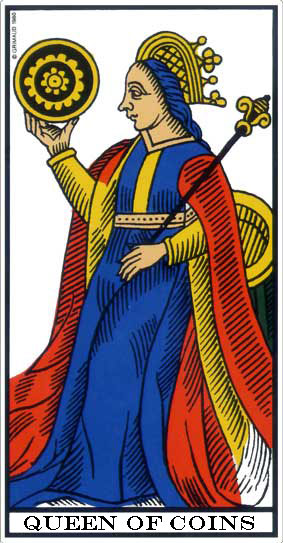
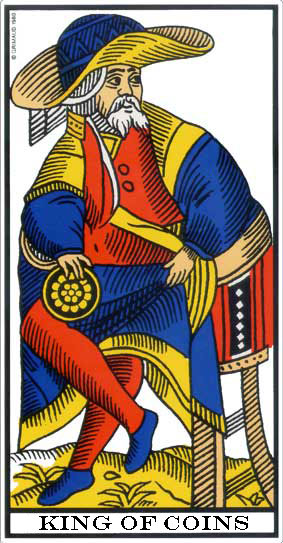


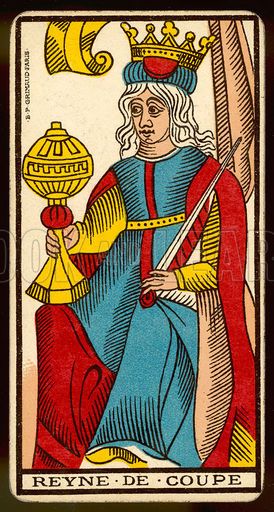
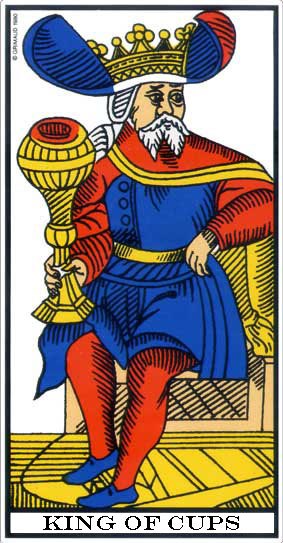
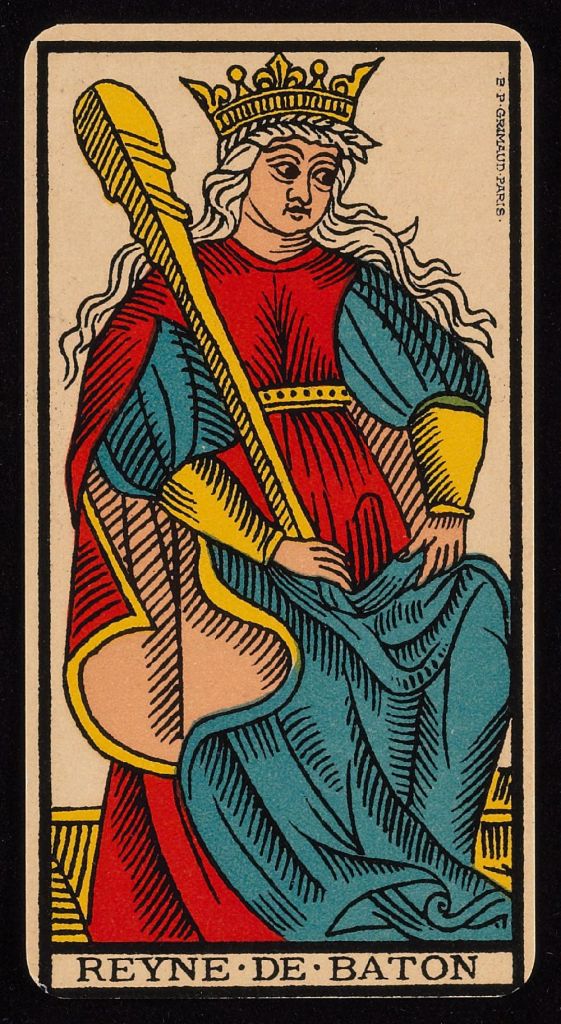
There are only a few features that are mutually indicated. There’s no throne in the Queen?
If that shape in the blue is her knee, it would seem the left legs are in the same position.
The question of the throne. The King of Batons seems to be wrapped in his throne, like the throne is simultaneously his garment. Like he’s a spool with thread around a piece of a spinning wheel.
His baton is like a drop spindle (we’ve noticed something like a drop spindle in the Minors Arcana before…but when??) [I looked it up just now while transcribing, it was the Ace of Batons I and Six of Batons II]
In the Queen, the garment and the throne are fully united. In the King, they unfold and differentiate.
There is nothing incomplete in the King and Queen of Batons.
Elaborate?
Before, each Arcana manifested as a duality, especially in the Coins, where at first you perceived one particular archetype being manifested, but then noticed it was also manifesting the opposite, or that each archetype seemed to bear its shadow or counterpart or opposite within itself. Akin to the Magician being “concentration without effort” and “charlatanism” at the same time. Here it’s kind of the opposite. Initially you perceive the Queen and King of Batons as two separate Arcana, two separate beings. Yet once you live with them longer and more deeply, you realize they are expressing a unity, they are one image—or an earlier and later stage of one being.
And yet at the same time, each of them is complete on his or her own. The Queen is the earlier stage, but she is not undeveloped. The King is the later stage, but he is not overly fixed. Paradoxically, she appears to be older and he appears to be younger.
She’s maybe more powerful or creative. He’s more extravagant.
She’s reminiscent of the old woman in George MacDonald’s fairy tales. The grandmother in Princess and the Goblin. The Wise Woman. He’s more like the impetuous Youth who becomes the 4th King in Goethe’s Green Snake. Or he’s Curdie from Princess and the Goblin.
The wing on his right sleeve is akin to the Knave of Cups.
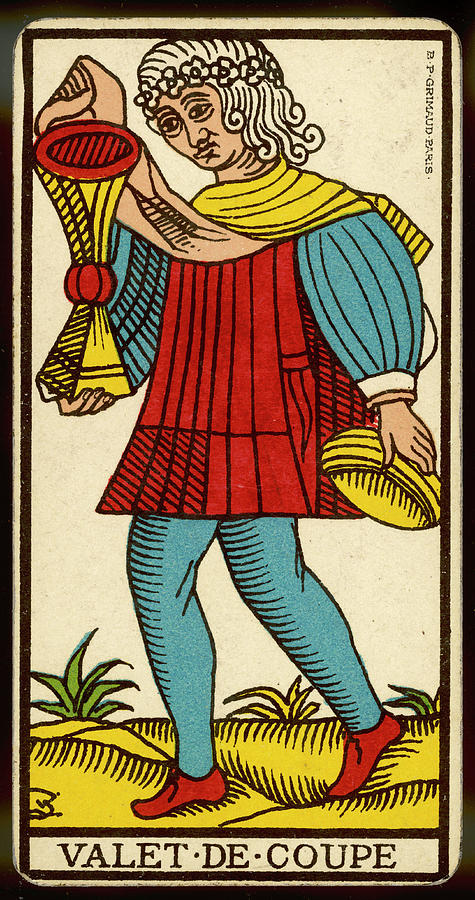
It’s strange that there’s frequently something awkward happening with the right arm in the Court Minors. A split and a break from the pattern. Certain cards in particular. The King of Cups, the Queen of Swords. Knights of Cups and Swords.

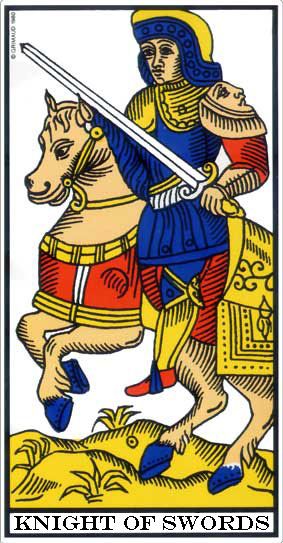
With the Knight of Cups, the cup itself is so large. Everything is oriented around it, like the rest of it was added piece by piece as an afterthought. Either the cup is huge or everything else is not to scale properly. Tiny horse, giant man?
These last two Minors are so harmonious. They stil have these elements (e.g. strange right arm), but not separated from the overall harmony.
Is the King’s baton part of the chair? That’s the question, isn’t it…is it an inversion of the chair piece on his left side? Are the baton and “blue wing” the inverse of the white swoopy chair back and blue pillar?
It begs a reference to plastic malleability. There isn’t a chair that is just statically formed that way. This can only imply a morphing of something unreal.
Only his right arm is discontinuous. The rest goes together. Why? Does it indicate something? The red forearm that ends at the elbow…seems awkward?
Neither the King nor the Knave of Cups has a very powerful look about them. The King looks worried, and the Knave looks old, dying, defeated. Actually, none of the Arcana with the “right arm issue” looks very powerful. A kind of disability, a diminishment of normal functioning.
But not with the King. His overall look is powerful.
He is stitching the throne. At the start, the baton is in the throne, as in the Queen. He draws/stitches the throne out of the primal substance. Once he finishes, he flips the baton around, installs the baton as the other pillar, his right arm would be finished.
Akin to the Magician, with the table missing a leg…this is a glimpse into that off-screen world that the table goes into.

Once the throne was completely stitched/drawn, and the baton was installed as a pillar, you wouldn’t even see it as a baton.
The pillars would be kind of inverse colors. White pillar with a blue swoop on his right side, blue pillar with a flesh-colored swoop on his left.
If it is like the Magician—whose left leg is the fourth table leg—the baton and all to his right would be covered. We assume a symmetrical throne just like we assume a 4th table leg.
All elements of the other Suits are active and integrated here. This has to do with the Suit of Swords in particular. The thing that alternates back and forth in the Swords, the world inside the cocoon. The goo taking shape in a magical way.
It’s interesting that there’s a pommel shape at the base of his baton, akin to the Swords. And with that pen-point, it’s like a miniature sword down there. Is his baton actually all of the objects united? Coin at the top, baton as the main body, cup as the pommel shape, sword as the pen-point? Four distinct regions.
With this King, we are at the 4th of the 4th.
The square on the floor—Four.
Come to think of it—none of the Kings has a finished throne:
He’s the only one where you can actually see the finished throne developing. THe only one with an element of it above the shoulders.
The baton as the tool used to make the throne, which is also the last piece of the throne to be installed. It becomes one with that which it creates, finishes it. It’s not just the tool creating itself, or the art creating the artist, this is a higher stage. Yet also more approachable. Like if the hammer became the leg of the chair. Or the paintbrush was part of the picture frame.
It’s a higher order of the Swords. In the Swords it is the art unfolding the artist through a metamorophic catharsis. Instead, with the Batons it is the art being completed by its own implement. He is mastering the art/metamorphosis, not the other way around as in the Swords.
So…is the Magician actually in the process of making the table leg that we assumed was already there? Has he used that table leg to make the rest of the table? We’ve never considered that…A scepter hidden in the table leg. A treasure or secrete message hidden in the mundane.
The stone that the builders rejected. The scepter that the King or the Priest rejected?
A strong theme in the Batons—the life of the tree stays within the Baton, the club.
The Sword, on the other hand, has no life in it—it makes the opening for life to work through.
Here it is finishing that life—it becomes a part of the final, ornate form (of the throne). Unlike the wild Ace of Batons, full of life—here it is uniquely ornate and formed.

The Queen of Swords has a throne that is the closest to what he is forming. But the right side of her throne is obscured by her sword.
The King of Batons is like a glimpse behind the scenes—what leads to the Pope, the Chariot, and especially Justice. The King of Batons leads to them. Hidden Batons.


The King of Batons emphasizes the throne without depicting it so clearly. A very “Four” element (the fourth term in the Empress, after crown, scepter and shield).
In the Numbered Batons, it was like the scepter and shield were united, many scepters uniting to become a shield. The Authority laying itself down in order to create a community of free beings. And now in the King of Batons, the scepter is becoming a piece of the throne—one of the frozen wings?
Is there a deeper, dual connection between the throne and the shield?
In the Empress, there is an overcoming of fallen elements, a working together to restore them. The throne in particular is fallen. It is Nature in her unfree state.
In the Numbered Batons, the individual Authorities (scepters) weave together to form the shield, which bears the sign of the Eagle, of Liberty. So the ideal of liberty is composed in such a way that it protects this ideal, it has the strength of interwoven scepters. Community strengthened by free individuals, and free individuals protected by community.
Whereas here, in the King, both the shield-tapestry (the weaving garment of the Queen has become the shield/stomach plate of the King) and the scepter are being integrated into the throne, creating the throne itself. A culmination. Both Authority (scepter) and free community (shield tapestry) being integrated into Nature. The ideal of the Eagle becoming real.
In the end, what in the Empress is
Crown
Scepter
Shield
Throne
As a kind of descending hierarchy becomes simply
Crown
Throne (containing Scepter and Shield)
The Queen and King of Batons are a bit like the Empress and Emperor, yet unfallen. No need of a shield. No frozen wings. All is still in a primal state.

The Queen of Batons is like the meeting of the High Priestess and the Empress. The pure Empress. The King of Batons is the meeting of the Magician and the Emperor. The youthful Emperor, who leans forward, not back.
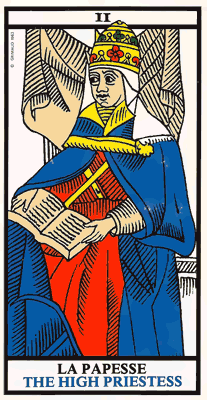

Maybe even the crown, the first and most transcendent of the four elements in the Empress, is becoming merely a hat.
The gold tips of the Magician’s curls—is there any other figure who has that feature?—it’s like the gold of the crown has descended into his hair.
The Queen of Batons’ hair was uniting with her crown.
The crown integrating into the head. The shield is integrating into the gut in the King of Batons. A kind of animal/insect, with a hive-mind intelligence, circle eyes. A more extreme version of the fish-owl-man Knave of Swords.
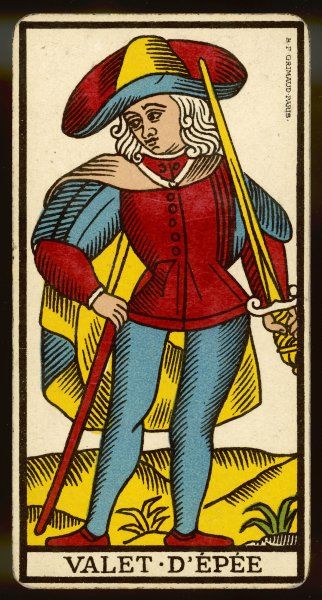
Maybe the crown and the shield are integrated into the clothing? And the scepter and throne unite.
It’s like…a hypothesis coming out of the Majors, that is demonstrated in its practical result in the Minors, a back and forth.
The ideas around the King and Queen are archetype-forming structures. Structures acting out the archetype, creating the opportunity for the archetype to create again. But all in a fallen state.
A need to see the unfallen at work in its own sphere…and then how restoration plays out in the path of the real, in the realm of the fallen…and how is it part of the metamorphic process.
This has been living with Phillip ever since we began the Queen.
At the very outset, Tomberg brings in this threefold picture of the secret, the Arcanum, and the Mystery. Seven colors, seven levels of the Mystery.
But the Tarot are at the level of Arcana. Tomberg never really discloses what is Mystery vs Arcanum, and maybe by the very nature of the Mystery, it’s impossible to do so.
But maybe the Mystery is unfolding itself constantly…the ecumenic circle that the Hermit perpetualy walks is the metamorphic cycle…the Arcana are the school of understanding the metamorphic path that proceeds in this circle. And yet it also accurs “above”, in an unfallen way, and “below” in a fallen way. What is the relationship of life/death with fallen/unfallen?
We come back around to the fundamental picture that grew out of the Ace of Coins. That the “one thing” is primary, and it is in the center. That “above” and “below” or “transcendent” and “immanent” are secondary, and arise out of the “one thing” in the center, by a “single act of adaptation.” The Arcana, the Tarot are in the center. The Mystery is that which is above and that which is below. And so the ecumenic circle becomes:

It’s more like we’re walking on an endless MC Escher spiral staircase, not a circle:
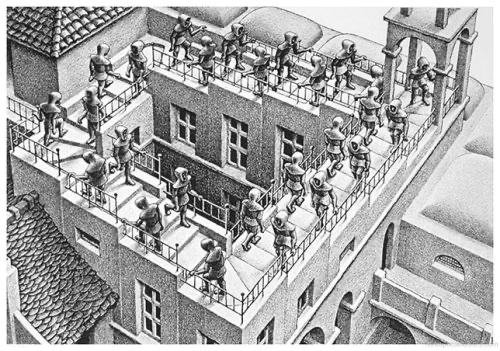
Through doing all 78 Arcana, it’s like we’ve experienced this portion of the (endless) spiral:
Maybe the more one moves through the 22 Majors and the 56 Minors, back and forth, the higher one ascends and the lower one descends on the spiral.
Are the Majors higher, and the Minors lower? Or vice versa? Each time you go through, you climb or descend.
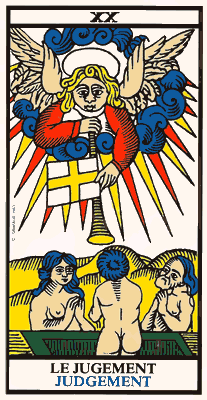
The image of making wings while in the cocoon chaos. The last stage in the transformation from a grub to a bug that can fly away. The 20th Major, the Judgement:
The tip of his Baton is like a stinger. A beesting. The serpent biting the hell. It’s pointed right at his heel.
The Suit of Coins had this dualistic expression of positive vs negative archetype. Not good vs evil. No moral judgement involved. On a lower plane there is good vs evil. On a higher plane there is simply two sides of wholeness, two necessary sides of wholeness.
A bee sting is good for arthritis. Salicylic acid, good for the aging process.
 The Unknown Friends