Notes of a Hermetic Conversation between Phillip and Joel on May 28, 2023
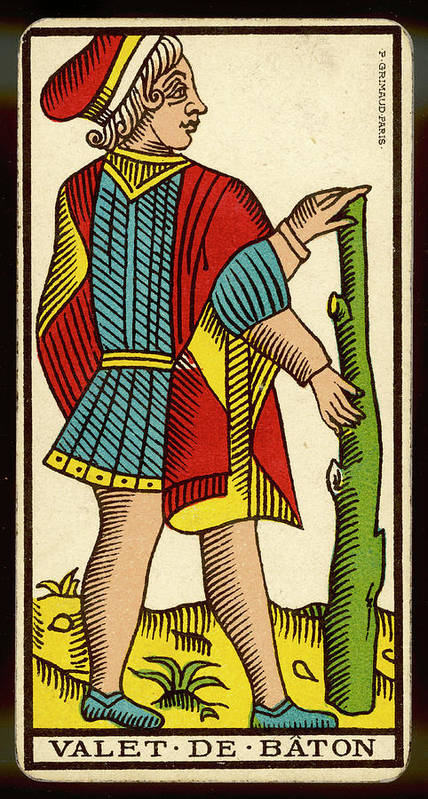
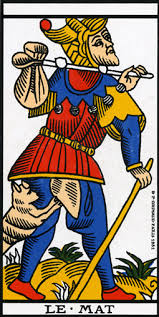
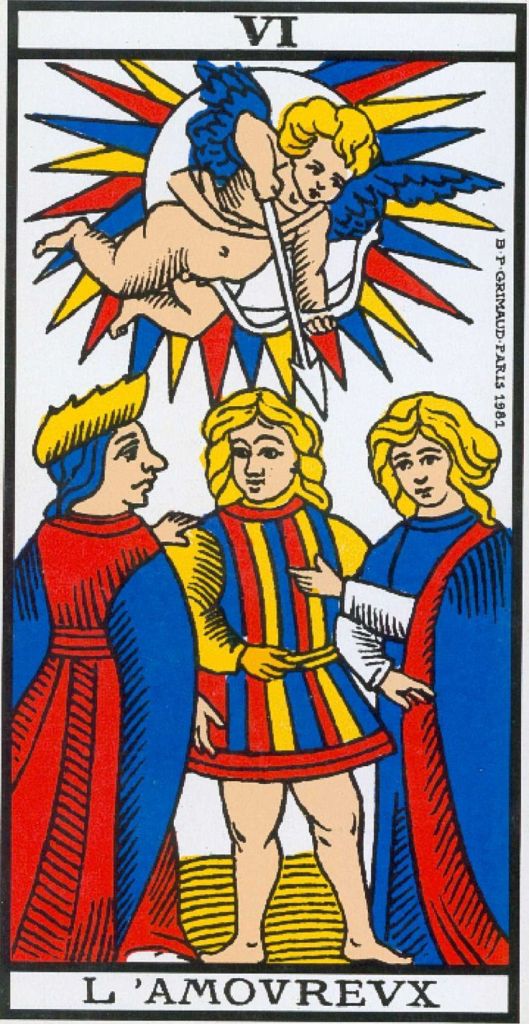
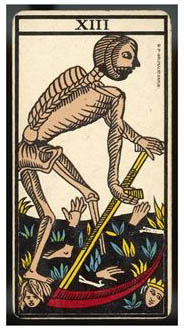
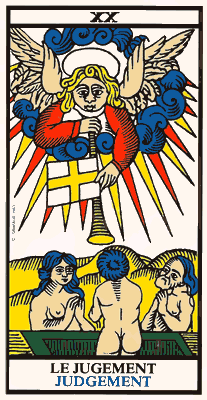
His back is facing us. What other Arcana have figures with their backs facing us? The Fool, The Lover (left hand figure), Death, and most of all The Judgement.
The hand pattern of the left hand figure in the Lover is remarkably similar to the Knave’s.
We have a real set here. The Fool and Death have a similar position, they belong together. As do the Lover and Judgement: the arrangement of three figures felow and an Angelic being above is the same in both.
But on the other hand, the Fool is related to the Lover—the Fool is totally absorbed in the Fire of Love. Whereas the Judgement is the counterbalance to Death, the resurrection after death. So these four images have a strong interrelationship.
The only image with a flag is the Judgement, the banner on the trumpet. This is related to the pendant-form created by the arms of the Knave in relation to his baton. That might be a plausible reason to hold one’s arms that way, as a kind of primitive flag, sending some kind of signal.
Part of a game perhaps…get the ball through the opening.
The left hand figure in the Lover is indicating the reproductive region of the central figure with one hand, while holding a firm grip on the shoulder with the other. The central figure seems to respond: “Like this? I should hold my belt?” As though he is being instructed in the necessary restraint of the “lower man” that the Emperor is exemplifying.
Whereas the right hand figure is emphasising the activity of the heart, and also gesturing to protect the loins. An emphasis on purity. An instruction directed to the central figure, but she is also finding her role by affirming that instruction, exemplifying it.
An emphasis on the heart and the loins, just as we found with the branch stumps on the Knave’s baton, aligned with his heart and loins.
The absense of any emphasis on the head region of the central figure—instead it is replaced and/or pierced by the Angel’s activity above. “Now I can pierce you—if you can grasp and exercise this teaching. Here is the dart of love.”
The Knave is like the preliminary teaching or training, before it is put into action as it is in the Lover.
Seeing the Knave’s baton as a new sapling growing, after the winter. He hasn’t actually attempted the task yet, or seen the Angel that comes in its wake.
Take the growth in the heart realm, and move it into the will. Take the activity of the will and bring it into the heart.
A bit the opposite of the Knight’s practice: “O human being, stream the like of thinking into the depths of will; raise the light of the will into the heart and hands. Experience it in the creativity of heart and hands, and stream what is experienced into the depths of will. Then raise creative power again to the head’s heights.” More of an emphasis in the Knave on heart and will, instead of thought and will with heart in between.
Maybe this isn’t so much a threefold activity of thinking, feeling, and willing, as it is in the Knight’s practice. Maybe we’re looking more at the central pillar of the Sephiroth Tree instead.
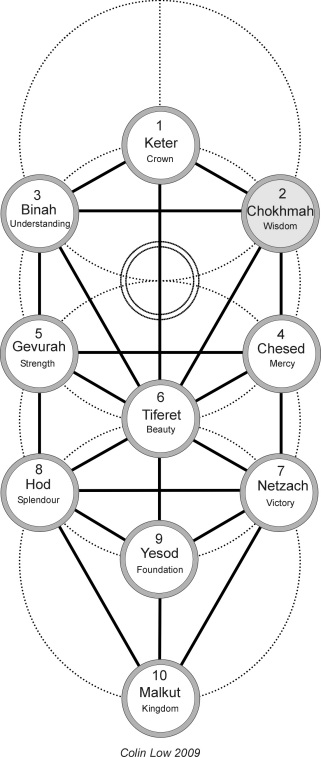
Kether, aligned with the crown. Tiferet in the region of the heart. Yesod in the loins. Malkut in the feet. The Knave as pictured has the bottom stump aligned with the feet (Malkut), the central stump aligned with the loins (Yesod) and the upper stump aligned with the heart (Tiferet). Were he to rotate his baton 180°, the Malkut stump would move all the way to Kether, while Tiferet and Yesod would exchange places.
More of a fourfoldness. Ego, astral, etheric, physical? There is a direct relationship between Ego and Physical on the one hand, and astral and etheric on the other, as laid out by Steiner in, for example, the Curative Course (https://rsarchive.org/Lectures/GA317/English/RSP1972/19240627p01.html).
It also brings to mind the three Great Arcana, from page 509 of Meditations. The Great Magical Arcanum between the hips (Netzach and Hod), the Great Moral Arcanum between the shoulders (Gedulah and Geburah), and the Great Arcanum of Knowledge between the right and left sides of the head (Chokmah and Binah). A kind of rotating of the Moral and the Magical that brings Knowledge right down into the Earth herself.
In the Village Lectures that Karl Koenig gave in the 60’s, he describes two main portions of life: learning and working. In our youth, we are primarily learning, which is a process of remembering that which we experienced in the spiritual world between death and rebirth, by being educated. When we are educated by priest, teacher, doctor, we are like a subtsance being worked upon by them. Then when we are older, the focus is more on working, and in doing so we create the future. When we work on the world, we are educating the world, we are educators of substance. These two different poles of life are exemplified by the Knave of Coins—who is being educated, learning—vs the Knave of Batons, who is working, who is educating the Earth.
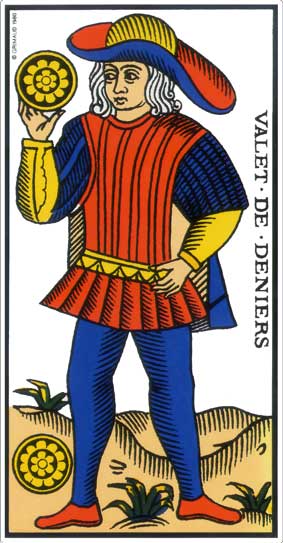
He is bringing knowledge into the Earth through the work he does with his baton. Here there is no longer any “coin”, he is done learning.
We can see the baton in this context as any number of work implements: he could be gardening, tilling the soil, using a hoe. Or even rowing, using a paddle. Moving the Earth along under his feet.
Or he could be shaping the instrument he wants to use. He has just felled and cut a piece of wood. Sizing it up. Is this piece right? Are the proportions proper for the tool I need to make?
Either way—whether creating the tool or using it—he is “educating” substance.
He is ready to make use of the moral and magical arcana to bring knowledge out of his head and out into the Earth (the bottom stump points outward, away from him).
We are brought again to this image that became actual in the Footwashing service: burying the hatchet, plunging the sword into the Earth when the battle is over. We can imagine some kind of metal point on one end of the baton which is hidden from us by being plunged into the ground. In fact, all throughout we have seen that the Batons have little blades on the ends.

The Batons are the Swords that are made into plowshares. Going to the battlefield after the war is over, finding all the left over weaponry of the fallen soldiers, repurposing it all for productive work.
The Suit of Coins is like primitive agriculture. No tools, digging by hand. The Batons are proper tools.
Is he a carpenter? A gardener?
Or perhaps this Baton that he holds did not have a blade on one end, perhaps it was like the Ace of Batons, radiant and flaming like a torch, and now this flame has been buried, plunged into the Earth.
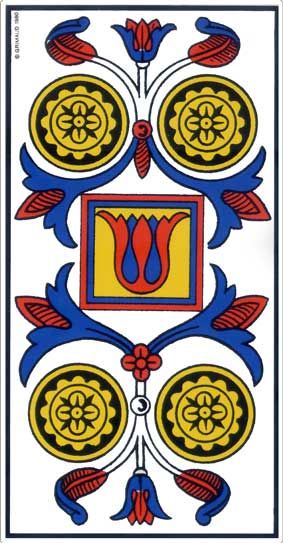

“Burying the hatchet.” Everything that this phrase implies. Letting go of the conflict, letting bygones be bygones, making peace. We can recognize that, if we take the King of Swords/Ace of Cups as a mirror point, the Knave of Batons is the mirror of the Four of Coins—fourth from the last vs the fourth from the beginning. And the Four of Coins was experienced for us as an opening of Pandora’s Box, opening the gates of Hell. The origin point of heavy conflicts. And here the Knave is shutting the gate by plunging the staff into the opening. Like Gandalf before the Balrog in Moria—”You shall not pass!” Actually shutting Pandora’s Box.
The Moral and Magical put to use to unite Knowledge with Earth in order to shut the Gates of Hell. The five wounds of the Pope: “And the Gates of Hell shall not prevail against you.”
We can imagine that the top of the Ace of Batons meets the middle of the Four of Coins—and these two flames complete and extinguish each other.
Going back to this false imagination in the Four. The flower in the center is not a real flower, it is the image of a flower, a failed attempt to avoid being Four and bringing in the Five artificially and before its time. And the true, radiating flower in the Ace of Batons has the power to be the antidote. The true Fifth, at the right time, come to take its place.
The contrast of the Tower of Babel vs Whitsun. The Tower of Babel as a false Whitsun event, an attempt to utilize the primal unity in a fallen way, before unique individuality has been developed—bringing about chaos and disorder. Remedied by the Whitsun event, wherein a circle of totally unique individuals is crowned and harmonized by the silent center of Mary, the true unity within diversity.
We could also see this implement of his as a giant spoon or eating utensil. Scooping up the Earth and eating it, taking Communion. The process becomes a loop, once begun—my Knowledge becomes Earth, and then I take in the Earth, the Earth becomes my Knowledge, my Being.
When we were describing the eurythmy last time, we had brought it into relationship with the five-pointed star meditation from the Knight’s pracice (see above). But this eurythmy with the copper rod is a seven-fold exercise, meant to be done within a seven pointed star. We begin with rod horizontal, at the waist. Then we move it down and move to the right “foot” of the star. We move it up and move to the left “hand” of the star. Then we hold it vertically to the right and move to the right “hip” of the star. Then vertically to the left, at the left “hip” of the star. “Then vertically to the right again at the right “hand” of the star. Then down horizontal, moving to the left “foot” of the star. Then horizontal over the head, back to the head of the star.
This is a more dynamic movement than the five-pointed star. In the context of the Knave of Batons, we would focus mainly on the three vertical moves at its core—the Knave is showing us the middle of those three (vertically to the left). Meaning the exercise begins and ends with the Knave’s baton reversed—we begin with the larger stump aligned with the head (knowledge, Kether), then move that to the Earth, while reversing heart and loins. We infuse the Earth with our knowledge in a moral/magical way. Then we take the “scoop” out of the Earth and bring it back to the head, consuming/absorbing our activity, and realigning heart and loins.
Steiner referred to one formation of the seven-pointed star as the “Lamb of God”:

(Although the eurythmy star described above would follow the other pattern of a seven-pointed star):

When the rod is held horizontally in the exercise, we can think of the lintel/frame. We find the green baton in this position in the Hanged Man, whereas his upright batons are yellow.
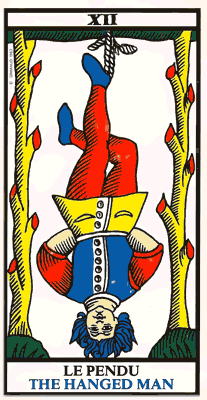
So we have the Ace = upright vertical, Hanged Man = horizontal, and the Knave of Batons = down-facing vertical. A kind of progression here, and we can imagine the Hanged Man being lowered into the Four of Coins’ pit of hell.
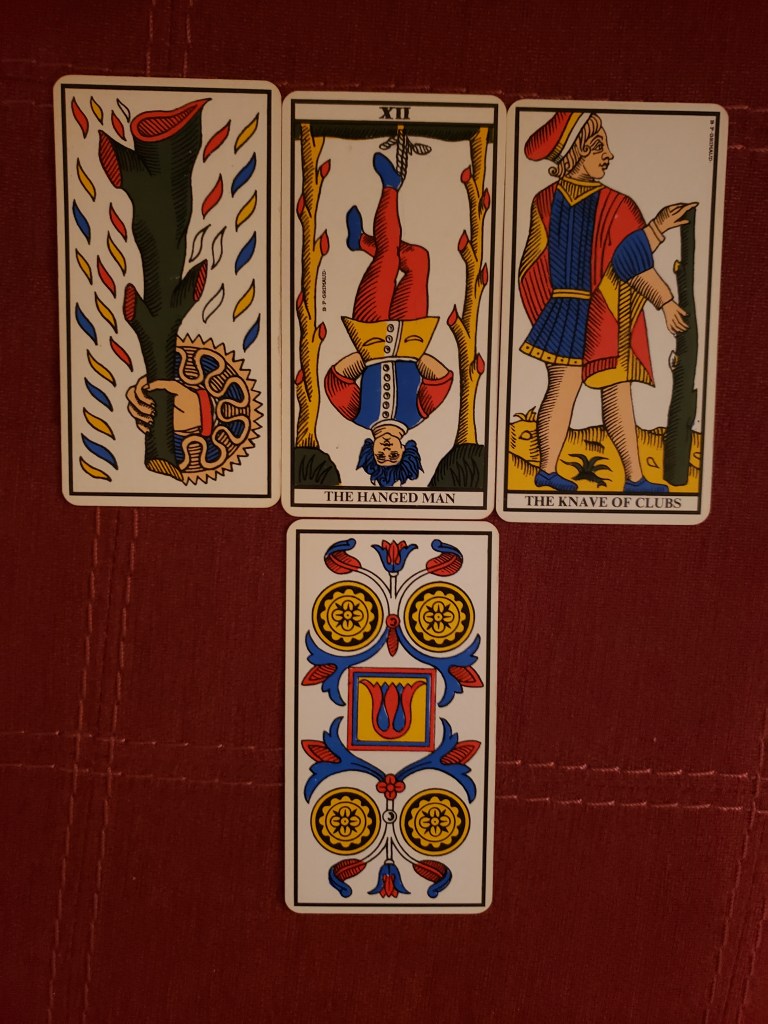
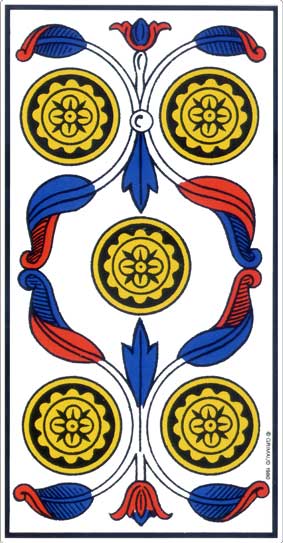
Is the Four of Coins false? Or does it just appear too early? Disruptive?
When the Final Cause appears at the end of all things, it resolves that which appeared in its form too soon.
Judith von Halle in her latest, Das Wort, gives a startling description of our current situation. The inner Earth is full of potential for the future (proper) evolution of the Earth. But dark powers seek to rob the inner earth of this potent substance and use it before its time, unleashing evil onto the world. It is a question after reading what she has to say whether there is any remediation after such an unleashing, or if evolution is permanently thrown off its proper trajectory.
But this gives one hope—the perspective that no matter how destructive this unleashing of forces too soon (as exemplified in the Four of Coins), when the true form appears, it remedies that which came before (exemplified in the Knave of Batons/Ace of Batons).
This same gesture is there in a smaller, temporary way in the transition from the Four of Coins to the Five of Coins, prefiguring the more comprehensive resolution that comes with the Ace and Knave of Batons.
Last time we spoke of the Maypole. Some say the Maypole is meant to represent the axis of the Earth. This goes right to the heart of Judith von Halle’s indications, about the alignment of magnetic and geographic north at the time of Christ—that as they became closer and closer aligned, natural and spiritual upheavals became less intense, a kind of stillness created so that the Christ (I AM) could enter. The magnetic pole must be kept from shifting too quickly, or the Earth will be destroyed by sudden upheavals. It depends on our morality, our Michaelic iron, to keep this magnetic pole stable.
And it is as though the Knave is righting the axis, maintaining its rotation. One hand balancing, the other spinning. He becomes somewhat of an Atlas image.
But also the Emperor. Maintaining his post.

You get the feeling almost that if you pushed the baton towards him, his arms would scissor, like they were hinged, and the baton could integrate right into his side. Like he keeps it in that sleeve, it opens towards the baton.
The Knave of Coins has a trick up his sleeve—maybe the Knave of Batons has let it out?
The gun that unrolls a flag when fired. Reverse that. He gets compressed into the baton. He is the flag that has unrolled from the baton. The scroll getting rolled up, starting over (Four of Coins). Scroll getting rolled up, or being unrolled.
A preview of the Knight of Batons:
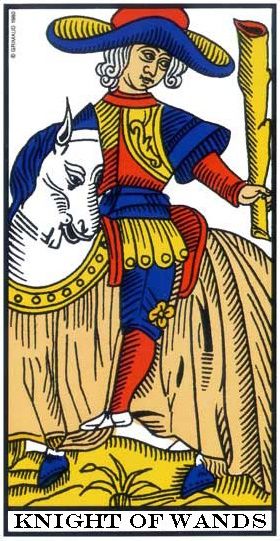
The orange flower on his leg.
We’re back to a yellow baton, like the Hanged Man and the Numbered Batons.
Strange horse covering. Ruffly. Is it flesh? Fleshy flower petals.
That is a huge-bodied, thick horse. It’s quite an expression on its face—is it laughing? What is the strange marking on its chin? The head vs the neck is hard to discern. It has very fancy eyebrows. Does the mane end in a point? Is it a unicorn?
His arm is coming out of a very wide sleeve. Like a Chinese yo-yo, the arm is the handle.
There are only two hooves?
The Knight is so embedded in this horse.
Such crazy garb on the horse…Joel thinks it looks like flayed flesh, like this is a ghost-horse, Halloween. Phillip sees it as very fancy, frilly, girly. Opposite impressions.
We’re back in the Magician’s hat.
 The Unknown Friends