Notes of a Hermetic Conversation amongst Joel, Phillip, and Brian on June 11, 2023.
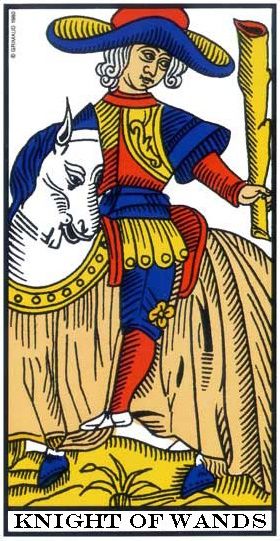

Does one of the horse’s legs (the back right) go behind the ground? Is it straddling the Earth?
The ground goes up in an odd way right at the front of the horse. This kind of swoosh of yellow that touches its robe. Maybe it’s a yellow hoof? Camoflaged, or united with the ground.
There is a strong resonance with the Magician, inasmuch as one of the legs of his table is hidden. Like the hidden leg(s) of the horse.
Also the hat and hair. Each of their left hands holds a baton. But their gazes are in two different directions.
Is the right hand of the Knight the horse’s head? As though half of the Knight is united with the horse…or concealed by it, like a puppet, his hand is inside the horse.
Concentration without effort. The directing center of consciousness moves from the head to the rhythmic system. The head of the horse—his directing center of consciousness is aligned with the region of the Knight’s heart.
The reigns on the horse as the equivalent of the Magician’s right arm…the right arm directs, becomes the reign, bridle, horse.
Mastering the horse. The Knight has mastery. Their gestures are one. The horse is one with the Knight’s will and focus. Even the gazes follow the same way.
It’s unique. The prior Knights don’t inspire much confidence.
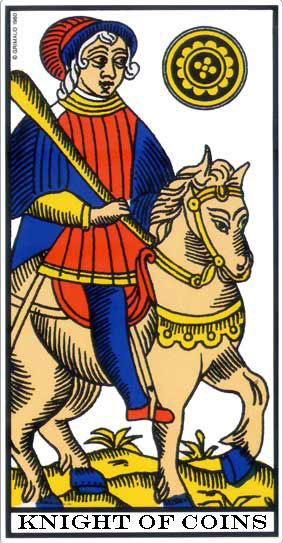

The Knight of Coins—just trotting along. Following the Coin in the sky, like the star in the east. Having this transformative experience from it, but also a bit hypnotized. Not directing, following.
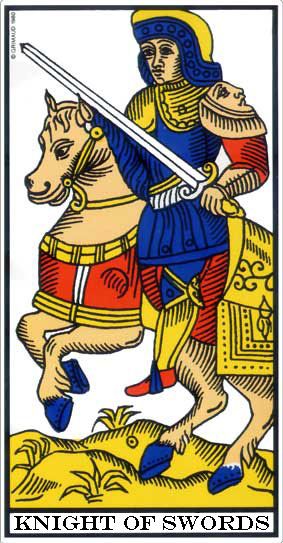
The Knight of Swords is dissolving into a multiplicity of beings. His horse is rearing up, out of control. He is at the whim of biological, evolutionary forces.
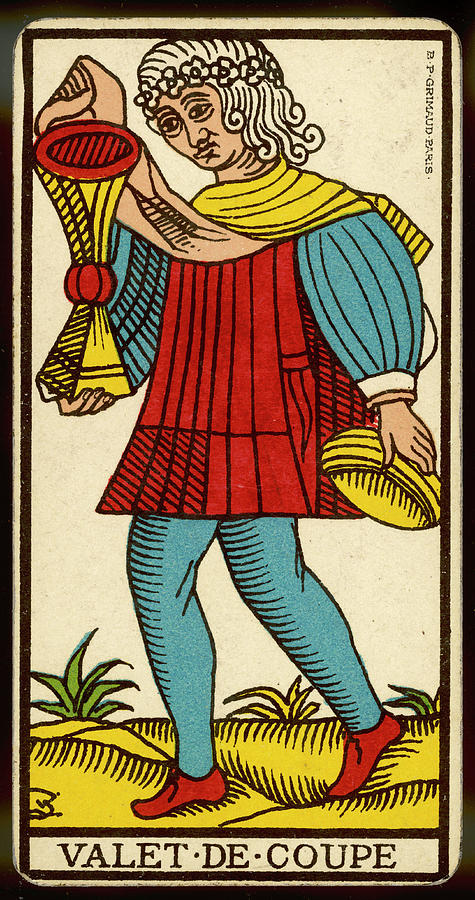
The Knight of Cups is peaceful, but he is being healed, renewed, put back together. His hand is reattaching to his arm via the cup. Convalescing.
It is unique that the Knight of Batons is facing both directions at once—one direction with his body, the other with his gaze. He has a universal awareness, unlike the other three.
He’s either making sure that the others are following him, or protecting the rear. The rear guard. Either way, a real awareness of backspace.
The Magician is not looking at what he’s doing. Concentration without effort. And neither are the Knight and his horse, they are not watching where they are going.
Is his baton a torch? Is it some kind of illumination? “Follow my light.”
The first four Major Arcana are this magical operation of uniting the ball and the baton to create the scepter.
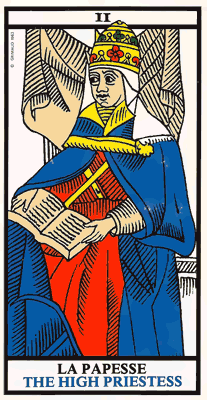


Is something similar happening here? The involvement of the horse’s head with the baton rather than the ball and wand?
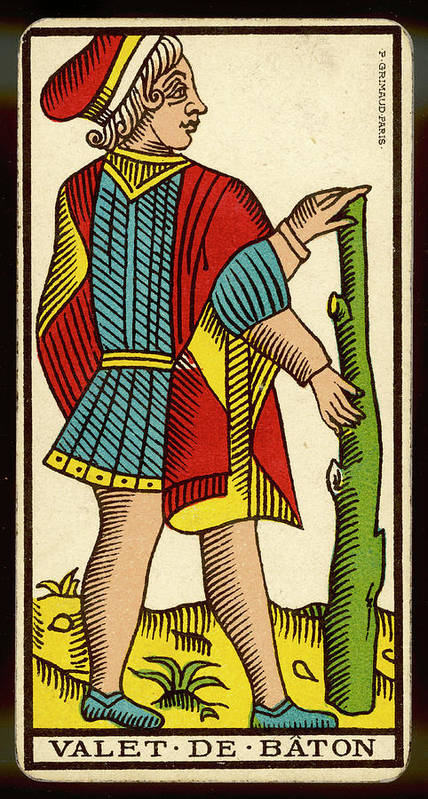
In the Knave of Batons, we saw the whole Earth below as the sphere of the scepter, the scepter held upside down. Now we have this horse’s head as the sphere. An evolution. The image of the horse rising out of the ground.
Is the horse on a hill? Kneeling on its front two legs? Notice the large white foot next to the Knight’s foot, looks like a bending horse leg.
Massive cloak.
The Knight is in control, without effort.
He holds the staff so much in the vertical.
Do they gaze at the staff, or beyond it?
This is certainly a step up from the Knave of Batons, another level of being.
Is he the only one who has the Magician’s hat? There are some that are similar. Force, Knave and King of Coins, King of Swords. King of Cups.

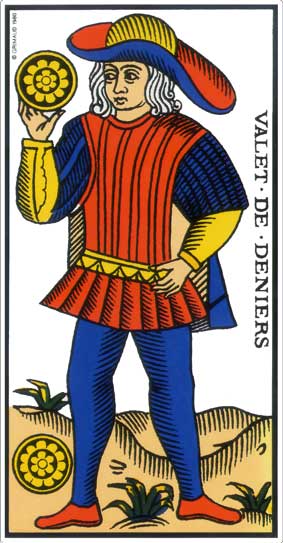
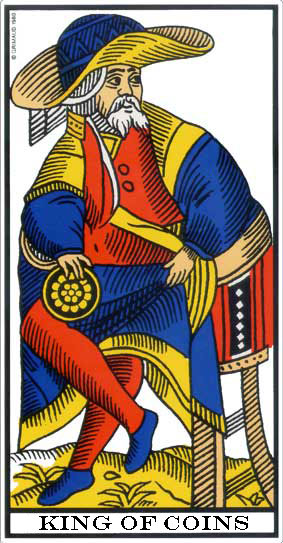

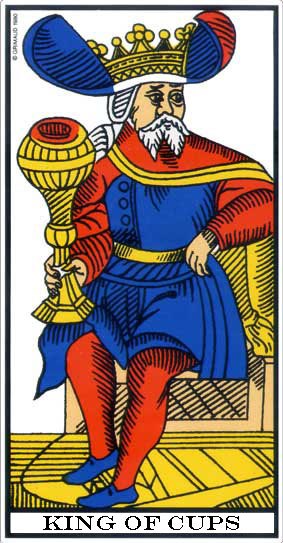
But this is the most similar of all. And the first Knight to have such a hat. The others are mostly Kings, and one Knave.
The Knave of Batons has a unique kingly quality (blue shoes). The Knight of Batons also has a kingly quality (lemniscate hat).
In the Knave, we have the element of Earth, the mineral kingdom, united to the Baton. Now we have the animal kingdom seeking union with the Baton in the form of the horse. Is the Baton the plant kingdom? A reuniting with the realm of the living.
It is both human and plant. The two kingdoms with a relationship to the vertical. The mineral and animal lack this.
The horse is so shrouded. Only his head and two hooves are clearly visible.
It is stunning that it is a white horse. That’s a first as well. The others were flesh-colored.
There is a strange formation on the horse’s neck—is it another face?
Like the Knight of Swords—another face growing out of his shoulder. Only this time, its the horse instead of him.
The flower is very central in the lower portion of the card. The orange color is so striking, so rare. The center of equilibrium for all that mass.
The Knight is very upright. Does he also have flower petals? Yellow ones? Four petals around his waist. The orange flower also has four petals. The fourth Suit.
The shape of his leg—its thin, and the swoop of it is quite distinctive. It clearly divides the front of the horse from the back.
His head is a circle of one.
His breast has these two swoops.
Then his middlehas three blue folds.
Then the four yellow petals. The descent of 1-2-3-4.
There are eight dots on the neck of the horse, as opposed to four on the horses of the Knight of Coins and Cups. There are some of the back of the Knight of Cups’ horse.
This horse is just huge compared to the others.
Similar to the horse being cleanly divided in two by the leg—the way he holds the baton at the bottom. It divides in two, he really pinches it. But he holds it in such an odd way. As though between his index and middle fingers. Why? Like he’s dealing a card or something. But with enough strength to squeeze the baton in two.
Its such an odd gesture/posture. Is he causing bulges to rise up in it? Trying to squeeze it?
The characters are experiencing some kind of draw that emanates from the Baton. On one level, it seems innocuous. Just a piece of wood, hacked into a certain shape.
But the Knight is really staring at it, and so is the horse. It is compelling them to engage.
Are they changing course to follow it? Like a dousing rod? “Oh, we have to turn around, it’s pointing over here.”
All of the Kings gaze to the left. He is gazing left.
For all of the Swords, the sword is what it appears to be. It is functional and symbolic, but not magical. Unless they are part of revealing metamorphic changes that appear to have happened.
Whereas the Baton is neither functional nor symbolic—it is magical. It’s implied that they are reacting to an emanating magnetism.
The Knave is so placid—more than naive, he had an innocent lack of involvement. It’s a purposeful neutrality. Like RP—deliberately creating a challeninging duality/dichotomy. Peaceful and powerful, something going on that’s not apparent. A peace that has to do with knowing, in contrast to the new-born blissful ignorance of the Knave of Swords.
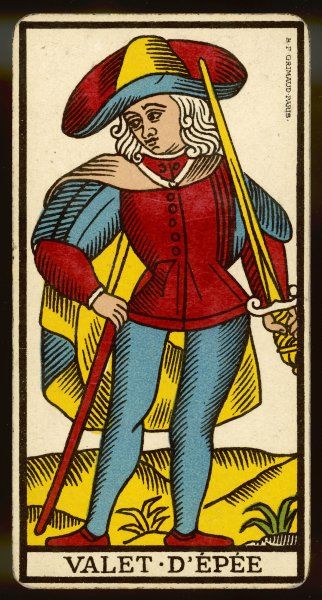
The Knight of Batons appears to be emanating fullness out of himself. On one hand, his whole being has been evolved by the force of the Baton, and yet on the other hand, he is the one directing, using the Baton. He is both in the presence, and approaching. He experiences both the inner and outer reality of the Baton. An outer force shaping him internally, yet an outer implement that he wields out of his inner forces.
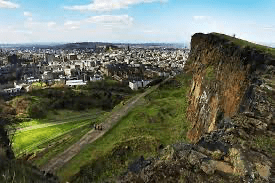
The cloth of the horse loks like carved wood. Or a cliff face. Crags. Arthur’s seat in Edinburgh. A giant horse growing out of the crag.

There is a bulb in the grass. A root vegetable. That’s the first time. Something coming to fruition.
Flowers in past Arcana—Temperance has a five-petaled red flower on her head. And the Knave of Cups is adorned with many white flowers.
Is there something coming off of the saddle? A bit of it below that seems to blend in with the shroud, or could simply be part of the shroud. Is it connected to the flower?
After the conversations on the Knave, Joel was left with more impressions—that there is a strong connection between the Hermit and the Knave of Batons, and that the Knave of Batons is some kind of gravedigger.
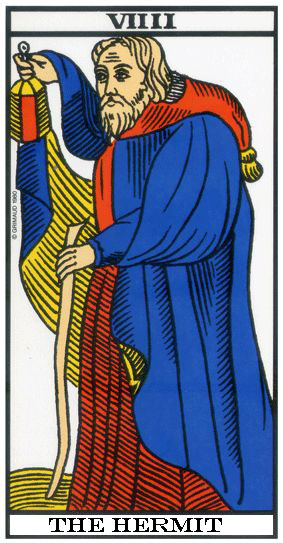
The Hermit taps the ground with his staff and illuminates the way in front of him with the lantern. It’s as though the Knave combines both staff and lantern into one, and puts the lamp into the ground. He illuminates the inner Earth. The Knight holds the lamp aloft again.
The staff represents empiricism? And the lamp is truth? What happens when you combine empiricism and truth?
The Earth in the Knave is like a living brainy goop. Perhaps from the light of truth puncturing it? A fully embodied transmission of life. The infusion of truth.
He is not the Hermit, tapping his staff, shining his light, very tame. The Knave is an upwelling of instinct and force of life, magical and thaumaturgic.
And out of this infusion…a fleshy, zombie-horse rises up. The magical creative act, totally at one with his will.
The cloak of the horse is a remnant of Earth. It hasn’t shed its cocoon yet. It turns like a spiral, following the very light-staff that gave birth to it.
There is such elegance and dignity in both the Knave and the Knight. All of their brute power doesn’t overwhelm their elegance and beauty. A great deal of magical power, totally in hand.
Bradley Rader brought the image of the fasces in relation to the Numbered Batons.
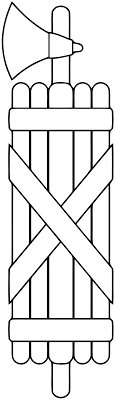
From https://en.wikipedia.org/wiki/Fasces:
The fasces, as a bundle of rods with an axe, was a grouping of all the equipment needed to inflict corporal or capital punishment. In ancient Rome, the bundle was a material symbol of a Roman magistrate‘s full civil and military power, known as imperium. They were carried in a procession with a magistrate by lictors, who carried the fasces and at times used the birch rods as punishment to enforce obedience with magisterial commands.
Fasces (English: /ˈfæsiːz/ FA-seez; Latin: [ˈfaskeːs]; a plurale tantum, from the Latin word fascis, meaning “bundle”; Italian: fascio littorio) is a bound bundle of wooden rods, sometimes including an axe (occasionally two axes) with its blade emerging. The fasces is an Italian symbol that had its origin in the Etruscan civilization and was passed on to ancient Rome, where it symbolized a magistrate‘s power and jurisdiction. The axe, originally associated with the labrys (Greek: λάβρυς, lábrys) the double-bitted axe, originally from Crete, is one of the oldest symbols of Greek civilization. To the Romans, it was known as a bipennis.[1]
The image has survived in the modern world as a representation of magisterial or collective power, law, and governance. The fasces frequently occurs as a charge in heraldry: it is present on the reverse of the U.S. Mercury dime coin and behind the podium in the United States House of Representatives; and it was the origin of the name of the National Fascist Party in Italy (from which the term fascism is derived).
During the first half of the twentieth century, both the fasces and the swastika (each symbol having its own unique ancient religious and mythological associations) became heavily identified with the fascist political movements of Benito Mussolini and Adolf Hitler. During this period the swastika became deeply stigmatized, but the fasces did not undergo a similar process outside Italy.
The fasces remained in use in many societies after World War II due to its already having been adopted and incorporated into the iconography of numerous governments outside Italy, prior to Mussolini. Such iconographical use persists in governmental and various other contexts. In contrast, the swastika remains in common usage only in Asia, where it originated as an ancient Hindu symbol, and in Navajo iconography, where its religious significance is entirely unrelated to, and predates, early 20th-century European fascism.
Who is able to weild this total power properly, with responsibility? The Emperor.
The Kings of the various Suits have a gaze full of the infinity of what is implied by this office. But the Knight—he spirals in on himslef, he enacts and returns to it as he enacts it. He can face it, whereas the Kings are dreading it.
Alexander the Great actually led the charge in his battles. The Supreme Commander. That would never happen nowadays. The commander is in some heavily protected room, watching it all on a screen. A severe level of removal. Obama and Hillary, planning drone attacks. So detached and protected.
In this Suit—the Knave is a King, the Knight is a King. Because they can properly wield and execute the Fasces.
The Idea of the Fasces—describing the unity of an office with the one enacting the office, vs the modern compartmentalization. The tendency to specialize and get removed from the wholeness.
The fasces closes the loop. Returning to the source of power. The way that Christ entered into Jesus of Nazareth. Jesus (Zarathustra) as the most advanced, ultimate human being, most expressive of potential…in order to be able to disassociate from his vessel to make way for Christ.
Fasces—unity with the source of power, wholness, only to abandon it.
Modern culture—highly isolated, subdivided “wholeness” of options.
The 2nd coming—a kind of specialization and emptiness that could be met, filled by the 2nd coming.
In the modern context, what does it mean to be connected to the fasces? What is the ideal for a modern person in a modern setting? Not as a king holding office—none of those offices exist anymore in a meaningful way.
Is the Suit of Batons showing this? Each of the four Court Batons is a King. Each must own the fasces for him or herself, not rely on an absolute king to do it. Turn around and face it.
Steiner’s social ethic, the form towards which we are meant to evolve: the healthy (heil, healing) social life is found when, in the mirror of each human soul, the whole community finds its reflection; and when, in the community, the virtue of each one is living.
Can we find each of the other three in each one of the Four? Each one reflects the others.
How does an individual in their inner being reflect all the others in their own stations of life?
The realization that fraternal economics is not an ideal, it is a description. I cannot, as an economic being, exist or operate alone. My entire being relies on the activity of everyone else on earth. The food I eat, the clothes I wear, the electricity powering my house and appliances—all rely on others, who rely on others, who rely on me.
More dynamic and interactive on a horizontal plane, vs a heirarchy of nobility with static reflection.
The Suit of Batons—heirarchy being leveled. The King is not so much at the top.
Going back to where we began—yes, the horse’s head is aligned with the Magician’s right arm, but that isn’t what he brings into union with the wand. It’s the ball, not his right arm. So the Knight wouldn’t be uniting the baton with the horse’s head. Really, it’s the four yellow petals (notice the yellow balls on them) and the fifth orange that are in the place of the ball. The blossom of the growing horse wants to connect with the baton.
The baton is his life going into the community. He is the product of the Baton activity of the community. His inner life reflects the work of the community—Baton reflects this soul life, sends it out into the community.
 The Unknown Friends
