Notes of a Hermetic Conversation between Phillip and Joel on June 19, 2023.
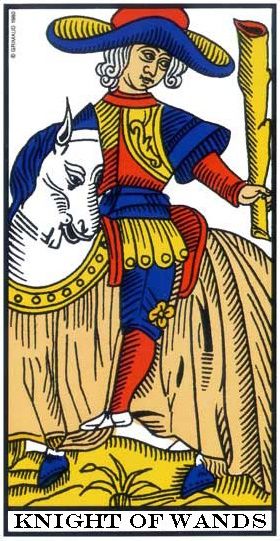

The orange plant next to the Empress’s feet (not visible in this version of the card), and the orange flower at the knee of the Knight. The orange plant in the Empress is the earliest appearance of orange, yet for ages we didn’t even notice it.
The horse in the Knight vs the Eagle in the Empress. Similar position/gesture. The cradling of the shield in the Empress is akin to the Knight’s arm that appears united to the head of the horse.
Steiner at one point describes Kalki Avatar as the rider on the white horse from the Apocalypse. The one who brings order. Joel was thinking of this all through our first conversation on the Knight of Batons.
The Kalki symbol vs the Eagle symbol.
There are no domestic animals in the Zodiac? At least, no pets. There is a ram and a bull, technically domestic.
Is a horse a pet? It’s not really raised for food. It’s not just maintained to be useful like a normal agricultural animal. It’s for transportion, for work. A working partner, or a tool in a way. Neither food nor just a pet. There is a close bond between horse and rider.
The Eagle = liberty in terms of the third Letter-Meditation. A horse is not about liberty. It’s about work, order, will.
It appears as though the horse came to life from the the ground, arose out of the earth. The shroud is like crumbling earth falling off of it, as it rises up. This vs. the Empress, where the future aim is to bring to life the throne, transform it into the Eagle. The aim and ground of work.
A living eagle, that projected the baton out of her navel. An ectoplasmic manifestation. The way she touches it, it could be a real eagle—as opposed to it only being a shield, which would make all of her actions merely symbolic and not magically real.
The band around her chest doesn’t go all the way around. Sometimes these features continue, but with a different coloring or something. Here, it just disappears once it runs into her baton. It’s like the eagle is casting something over. The two of them are making the baton happen. It’s perhaps not supposed to be a band around her chest, but rather a contact between eagle and baton, like a golden rainbow.
Looking to the chest of the Knight—what is this badge? Or is it a wound over his heart? Or the flame that belongs on his torch (baton)? Is it the emblem of his station?
Do we recognize this form from prior Arcana? Is it related to the Ace of Coins? Or the Two of Coins?


It is similar to the Eagle’s wings.
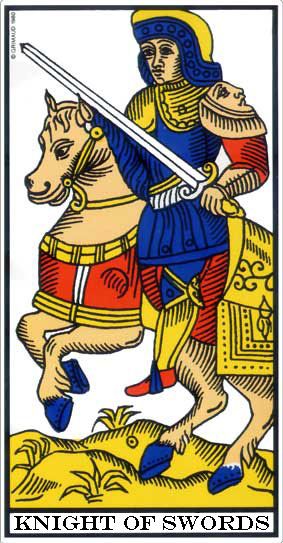
We both feel this similarity, or familiarity. It’s not exactly akin to anything in the Ace of Coins. We can sort of see it in the two. This seahorse shape. It’s vaguely like the shapes on the Knight of Swords.
It seems to be embedded in the various plant forms, in one way or the other, throughout the Numbered Minors.
The plant has been with us since the beginning (Ace of Coins). Here the plant finally has its own Suit.
It’s not presented overtly throughout—for the most part we see this yellow staff with a blade at the end, a bit of a Sword reference all throughout the Numbered Batons. But from the very outset, in the Ace, the Baton is represented as a cut-off limb of a tree.


Reading from pages 69-70 of MOT. All we have seen are branches (throughout the other Suits). Now all that is left is the trunk, stripped of those branches. Where do we actually see the entire plant/tree in its wholeness?
Bradley Rader—are the true forms of the Arcana invisible, are these “fallen” or distorted images? Does the true form slowly reveal itself, once each Arcanum has been unveiled and they can all be united into one?
The Star has a tree:

Is the bird the Sword?
The stars above her = Coins
Her cups = Cups
The bird = Swords? or the River?
The trees = Batons
This is the only Arcanum which shows the tree, trunk and branches united.
Maybe there are no longer Swords once the whole is represented? Swords can only manifest once there is division and/or a lack?
Like Slytherin house in the Harry Potter series. The “necessary evil” of the 4th element.
Or Susan at the end of the Chronicles of Narnia. Only three of the children make their way to Eternal Narnia.
Hermeticism is the 4th element, after Mysticism, Gnosis, Sacred Magic. Does it get left behind?
Is Hermeticism formed out of the manifestation and working together of these three ideally inseparable portions? Therefore it is immanent within them, not actually a distinct 4th portion in its own right?
If Sacred Magic contains the other two—if it is already a summary—why do we need Hermeticism as a summary as well?
We can’t really understand any one of them without realizing it is inseparable from the other two. Can we even authentically look at them separately then? This rings true, yet seems incomprehensive. The proper analogy is with the Holy Trinity, where one can run into the same intellectual argument/dilemma. “If they are all One, why not just talk about God as One, then?” But this is exactly the shortcoming of Islam. The mystery of the One God can only be properly expressed and approached through the three-in-one simultaneity.
The trunk de-limbed. The other Suits are the other elements, stripped away as inessential.
Yet the Knight of Batons is so full of life—he even has a flower growing out of his body.
The flame-leaf emblazoning his armor.
The death of the Tree of Life is yet more living than the “living” elements removed from it.
The limbs removed vs the trunk itself. The illicit occult work of someone like Aleister Crowley, the creation of a “moonchild” with L Ron Hubbard, etc.
Someone connected to the initiates (not the initiate him or herself) goes into a dream realm, sees the initiates at work—and is utterly horrified. Existential crisis. “You’re not ready—but this is reality for the initiate.” Steiner—knowing of the falling brick and doing nothing about it. Seeing the transcendent realm beyond death. It goes beyond the instinctive terror in relation to death, to avoid it at all costs. Embarking on the journey to transcend the end of all things that can be—impossible to transcend.
(Joel has to stop getting distracted by noticing things about the Empress that he’s never noticed before).
The flesh color of the horse is stronger than the flesh color of the Empress’s throne:
Does it have something to do with the Minors? Do they have more vibrant color than the Majors do? There’s a bit of orange in the very fringe of the horse’s robe.
The Knight of Swords doesn’t look so good, compared to this floating, glowing Knight of Batons.
Looking again at our story:

Stage One of the path is the Knave of Batons, the pure experience of concentration on the details—of an external or internal perception.
Stage Three is the confrontation with a revelatory spiritual content (Knight of Coins) that leads to a transformation of consciousness (Knave of Swords). Both speak to this naive revelatory state.
Stage Three sees a resulting process of metamorphosis (Queen of Coins) that becomes sickly, exaggerated and out of control (Knight of Swords) leading to death (Knave of Cups).
There is something here of the anointing of Magdalene: ready for sacrifice, for burial, going to tomb to mourn.
Stage Four has the dying novitiate enter the tent of healing (King of Batons) where he is mercifully slain by the Queen of Swords, begins to regenerate as the Knight of Cups, and is finally fully remade as the Knave of Batons.
Now we are at the next level—the King of Swords, Queen of Cups, Knight of Batons. Total power and majesty.
Compare the dying Knight of Swords with the rejuvenated Knight of Batons.
Both the Knave of Batons and Knight of Batons are on the level of Kings.
The King of Swords, a fully rejuvenated powerful being. Queen of Cups—a disply of self-sacrifice that only leads to more life. Like the trunk stripped of the branches. This life cannot die or wither, cannot be separated from the source. Its death only leads to more life.
The unfolding of the red ball from the Queen of Cups into the Knight of Batons. Takes over the crown/hat:

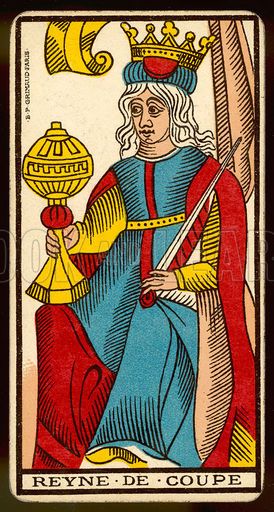
The ball of his hat looks separate. Different from the Knave of Coins or the Magician.
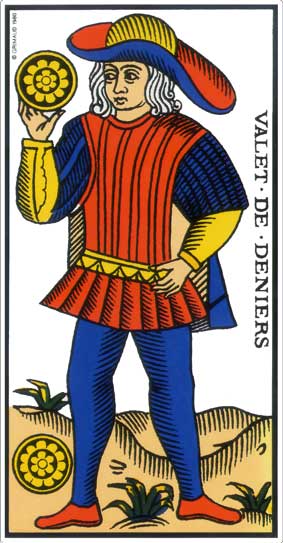

Her crown unfolds into his hat.
The King of Swords consolidates into the Queen of Cups, who then inverts into the Knight of Batons. So much more regal and noble than those that came before. They are like Father, Mother, Son almost. The Baton makes appearances in prior Arcana, but doesn’t look anything like his. Like it wasn’t the real one yet.
The Empress has one “acorn” of the condensed blood of the Grail at the base of her baton (the “voice” from The Judgement). He has many “acorns” (the circles on his fringe and the horse’s). Is this a choir of voices? A separated, multiplied chorus?
The Empress is the itention. The Knight of Batons is the realization, the deed is done. The acorn is dropped, and multiplies. It doesn’t need to maintain the connection to the baton any longer.
In the Empress, the elements are combined: staff, ball, cross. The Knight holds a stripped down, primal baton (staff). And the ball is on his head?
The Elements are separated in a primordial way—not as in “Anthroposophists don’t have Sacred Magic” or anything like that. More like Paradise. The elements come together for a part of the process and then separate. They are not always together in this fixed way.
We come to a different picture regarding Mysticism, Gnosis, Sacred Magic. Both-and. Sometimes they act as a unity, and sometimes they are separate.
Is the flame emblem on his chest somehow the Cross?
Does the horse need to be covered due to a kind of primal force in the atmosphere?
It’s so strange that his one arm is depicted with this big sleeve, where the arm suddenly pops out of it, whereas there is no arm shown at all on the other side.
His sleeve/garb looks very 17th century. Baroque. Unique in comparison to the other Arcana.
Does he have a very thin waist? Akin to the sleeve, a big sleeve with a tiny arm coming out of it. He has a large torso with a tiny waist coming out of it.
The horse is really thick, whereas he’s very slight. That tiny foot. And yet he’s not dainty, he’s no dandy. You don’t want to mess with this guy. Quick, capable, knows exactly what to do.
Maybe the Cross is the 4th element, after the ball, the staff, and the acorn? The 4th element may not be present, depending on the circumstances. Only there when there is union and therefore a “summary.”
But here we are in the 4th. Through the Cross we return to Paradise, where there is no Cross…
The three pass through and into the Cross and find a different relationship and way of being, no longer in reference to the Cross—somehow complete.
Is his badge like the flame of the Tower of Destruction? The “lightning bolt”? Is his staff the Tower?
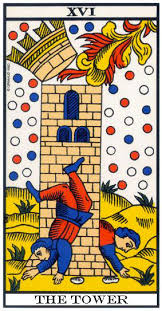
In a very different context. “I AM the flame.” Not the one struck by it. He is the one who casts down.
We can imagine that the Knight of Batons takes flight out of the activity of the Empress’s baton. The Eagle is frozen, but he is all mobility, a rider. He lacks wings yet flies. He looks behind him as he rides, this juxtaposition of movement (looking in one direction, traveling in another). Instead of wings, he has flame.
Of all the persona we’ve met, this is one we could meet in a dream. He wouldn’t look like this, but you can imagine who he is a reduction of.
“I’ll go with you wherever you lead. No explanation is needed.”
 The Unknown Friends