Notes of a Hermetic Conversation between Phillip and Joel on June 26, 2023
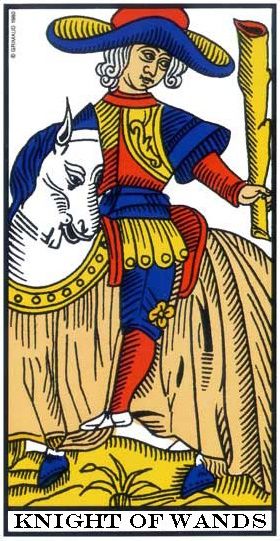
Is the mane of the horse his right arm? Is it the horse’s hair or his sleeve, shoulder?
Like a puppet. Muppet-like, this feathery hair arm. The hand would be controlling the mouth of the horse.
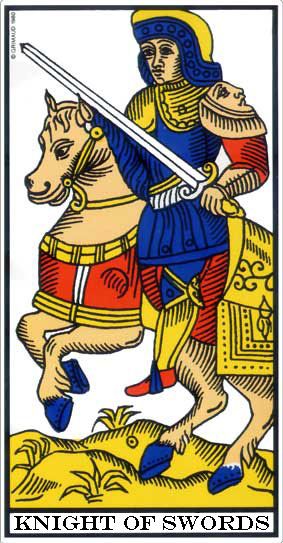
Reminiscent of the Knight of Swords, whose body parts were transforming into their own independent creatures in this out-of-control evolutionary process.
But the Knight of Batons isn’t dissolving into another being, or other beings—this is more of a partnership, more controlled.
He hasn’t disappeared. His hand is veiled within the horse.
Indistinct bifurcation. In the Knight of Swords, at first he was human, but now he’s transforming into something else, or a slew of other beings.
Here, the Knight of Batons is fully human and yet livingly puppeteering this partner being.
Judith von Halle: the full juxtaposition of bones (mineral) vs the blood produced in the center of the bones (the ego, the spirit). Warmth and ego, the newest emerging out of the oldest.
And since the blood is the newest, it bears the seeds for future potential and becoming within it. Something about blood not yet being fully developed, but as it develops it becomes a fruit—planted in the soil of the New Earth. Does it bear the seeds of the ego within it?
The maintaining of full individuality while finding an outlet through this other that you merge with without losing yourself. Maturing of ego within that.
The Baton he holds is like a yellowed bone, broken, showing some of the living marrow within.
The dead outer bark of a tree and its inner living sap are closely analogous to bones and blood.
Is the horse shedding its skin? A cocoon? Transformation? Reborn somehow. A metamorphosis.
This horse has this distinct pointed mohawk. Not found on any prior horse.
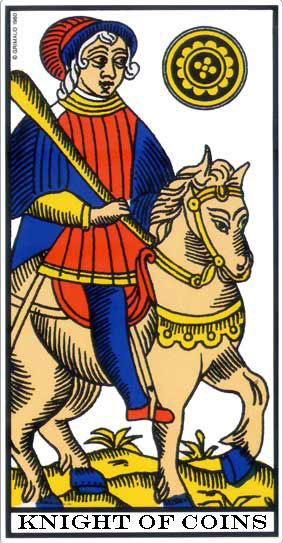

The other horses are flesh-colored, but there is one white ear on the Knight of Cups. Like in The Lion, the Witch, and the Wardrobe—when Aslan breathes on the statues, bringing them back to life, it begins as a trickle of life which slowly moves through the whole statue.
There’s no return to life for a zombie in a zombie film. The total opposite in true fairy tales.
The tattered veil that covers the horse. Like something is “off-screen”, in another realm. Without that veil, we wouldn’t be able to see the shape of the body of the horse. It’s required somehow. A ghost horse, an invisible body.
It the head is his puppet, and there’s nothing under the veil—then he’s flying, but he doesn’t want that to be known. He’s toning himself down to appear familiar to those who would be shocked by his true power.
Only two hooves are visible, unlike the other Knights. It doesn’t seem to be in motion. The head of the horse is turning, maybe its turning around. But it isn’t in mid-stride or gallop as the others appear to be.
The blood vs the fruit of the blood—the Suit of Coins as the fruit of the blood.
Something about unconsious warmth and selfhood in the blood. Coin. Currency from the past—you can spend it, do what you will with it. Then the fruit—like Christ, stepped beyond heredity and reconnected with the primal source.
The Warmth Course—boiling water, 100° C. You can apply as much heat as you want to water, but it will never get beyond 100° C. It transforms into steam.
So where is the heat going? It’s going into the phase transition instead of heat.
One quality of consciousness is running in a hereditary, intrinsic way, an ongoing cascade of structures, cause/effect—partially conscious, partially instinctive.
The other quality—it is warmth imbued with recognition. Take the structure into awareness, reorient to the sources of motive and force. Re-link back to the orginal source of life, consciousness, intention—this comes at the cost of disrupting the existing order.
Warmth, not so much much in outward changes, but an internal conversion.
Coin—what’s given out of the old way. Exchange, find satisfaction.
Steiner, in describing human thinking, compares it to grain. You can use grain as a food, you can grow it to consume it, and then its over. Or you can cultivate grain, save the grain, let it grow for its own sake, for further propogation. Our normal thinking is just consumption, we don’t usually gather it to replant it for further cultivation into what it would become out of its own nature and forces.
Perhaps we can think of “Coin” in a similar way, when we think of “Coin” as a fuel in relation to “Warmth” or “Heat.” We can gather the coin as heat, as increasing temperature, leading to a change of phase, a transformation…or we can just spend it immediately, keep existing in the “normal” mode.
The Coins are akin to this learning how to allocate resources to build up heat.
The Swords are the water boiling away slowly, on a simmer, not really getting any hotter.
The Cups are the steam.
The Batons are the liberated warmth.
The structure is disrupted in the Swords.
In the Cups, it is fruitful, productive, but not structured as it is in the Batons, where it is life-giving again.
The steam/fountain rising in the chest of the Knight of Cups, out of the “cup” around his waist.
The saddle in the Knight of Coins is akin to the form on the chest of the Knight of Batons.
Maybe the Knight of Coins is holding the “bone” and the bone was broken open in the Knight of Batons. Yet related to the cup, this red within yellow.
It’s such a huge horse in the Batons, and so tiny in the Cups. A giant on a tiny horse.
The front of his saddle is so strange. It eats into the neck/adornment of the horse. And he’s not using the back rest. He’s hiked up really far forward. In fact, it just looks like these two separate pieces with no real saddle in between. The saddle form is over his heart.
He has such tiny feet. So dainty. Have we seen white shoes like this before?
Actually, all of the Knights have tiny feet, but they all have red shoes. The Emperor is the one with white shoes.

When we speak of the horse being only a puppet-head, and nothing solid or visible beneath the veil, it’s akin to what we came to with the Pope: He’s a Void giving itself a face, holding up a mask, making itself appear human so that the acolytes will approach without terror.

The significant place is the vortex, the empty space. The heart—the empty space, the void. The latent warmth of a frog in winter? Living yet freezing cold?
Ancient Saturn. Freezing cold, with energetic flows of warmth.
Steiner indicates that his description of Ancient Saturn in Occult Science should remind one of the coming of Spring. Of ice thawing.
Warmth is the that which bridges emptiness and fullness, presence.
Only the Emperor has white shoes!
When you put them next to each other, it’s as though they are toasting each other—”Cheers!”
“Great job, we did it dude. We came to Earth, of our own volition. We’re on the ground.”
Well…the Emperor is on the ground. The Knight might not be.
He is on an entirely white horse. There is not much in the Arcana that is entirely white.
Ghost horse. Magic wand that might be a broken bone.
Like the last scenes from Bedknobs and Broomsticks, where a witch uses a magic spell to animate suits of armor to fight Nazis. Using sorcery, yet for the good—and making an unstoppable army. Indestructable.
A preview of the Queen:
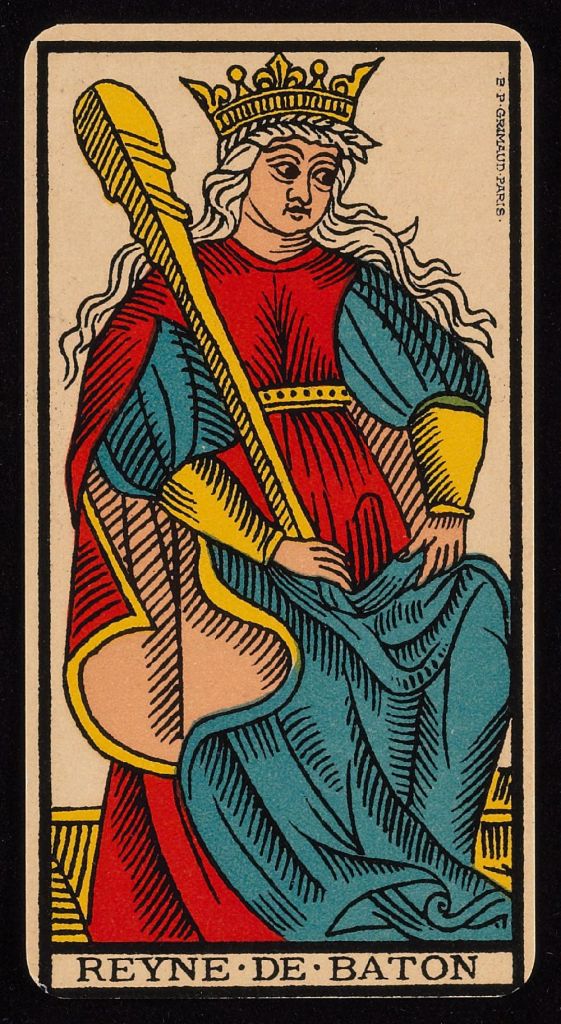
She’s like a cave woman. Magdalene when she began to live in the cave as a hermitess? Wild woman of the wilderness. Bit of a witch.
The forms at her feet. Like a cauldron. Flowing of waves.
The baton is like a club.
There is a tree-form, like a Christmas tree, on her chest due to the banding, cinching of her robes.
She is relatively unadorned. Simple. But her crown is pretty magnificent. The richness of fabric. So thick and billowing. Overlapping.
Her face, like the Knave of Batons, looks like a real face. The others don’t look so much like real beings.
Similar to the Pope, there is an entryway in her clothes.
She really is not clearly sitting or standing. She’s probably standing? Except there is a knee?

Her belly/hand position is akin to the Queen of Swords, but she is only holding the space for a head, not an actual head. Similar, again, to the Pope—emanating something substantial.
She’s sitting, but not on a chair, there is no chair. But she is in a room, not outdoors.
Almost like the substance of blue, the flow, the red is the structure that upholds her. The Pope is himself a portal. She is a structured flow of elements.
She could be standing, shaking a blanket—or grasping, stirring, like dough. Volatile flowing elements. Stirring the cauldron, but no cauldron. Unclogging, directing the flow.
Same swoop on the floor as on the Knight’s chest—and the head of the Knave!


Head (Knave), Heart (Knight), Feet (Queen)—the descent of something.
Is she catching a fish? With a spear, or a harpoon? Some fish-forms in that flow.
Witch-like. A destructive act that’s fully authorized.
The Pope is a void. She is handling the void. “I am going to make something.” The Star, but more personalised, more visceral, engaged.

 The Unknown Friends