Notes of a Hermetic Conversation between Phillip and Joel on July 20, 2023


Her hair becomes her crown, they weave into one another. The laurel leaf shape of her hair, the leaf shape in the crown. As opposed to earlier transformations that are more David Lynch-esque, she’s a human being gently morphing into a recognisable, noble human archetype.
Very natural. You don’t even notice. The shape of her bangs is what caught Joel’s eye.
Very captivated by the bottom portion of the image, the blue. So much activity. Waves. It’s almost like she is the crest of a wave. From below up rather than from her. She is the foaming crest, it isn’t just a wave washing up against her.
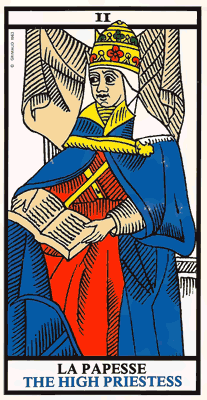
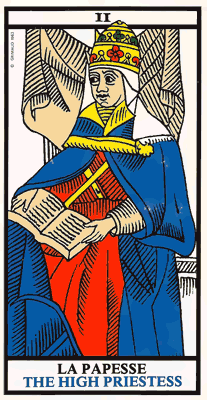
This card is reminiscent of the Two of Coins and the High Priestess. The “Two” figures very strongly.
That form at her feet is also a similar to the “tongue” and the blade on the Magician’s table.
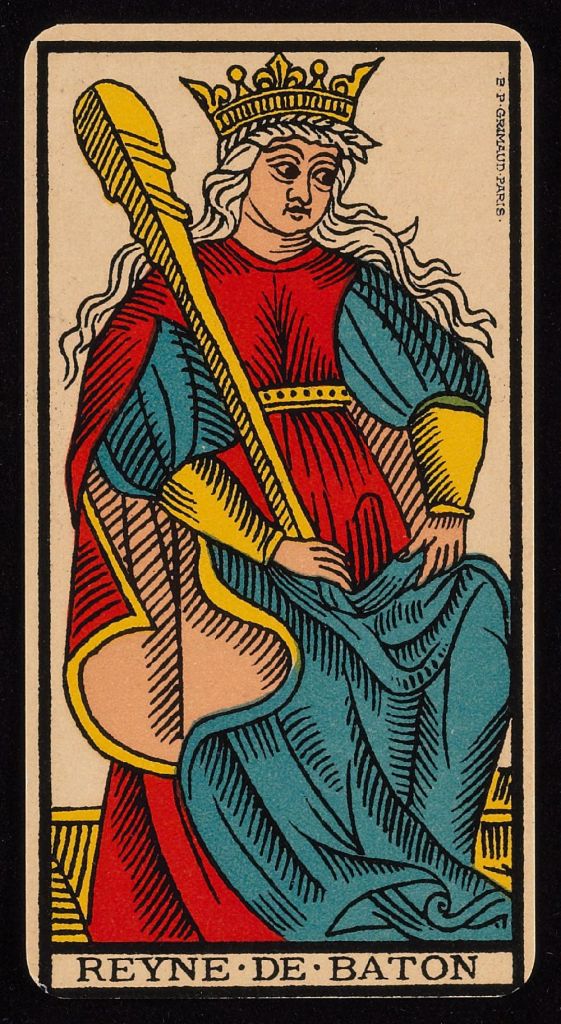

Like there is an opening there, just like the Magician’s bag…someting going in.
An inner reflective ladder, the chain of descent of reflection. Bag-like, a container.
The observations from MOT, the Letter-Meditation on the High Priestess. The chain of descent of reflection, the “ladder”: thought, then memory, then word, then book. The natural amplification of concentration without effort. A perceptual process and then a cognitive one.
The Queen of Batons as a total inversion of the High Priestess: the natural trajectory of life force itself. Living waters. An elemental queen. We are more in the realm of will/creativity than knowledge/gnosis.
In that sense we are also in the realm of the Empress, the sacred magical. An instinctive or primal relationship to the Empress with the baton. The magical object of power.

This flesh-colored opening in her robe—is this like the shield in the Empress? The first two terms—divine authority through the crown and divine power through the baton—are obvious, but where is the third term, the divine aim of the shield?
And in the Empress there is a 4th term—the throne, the object of the magical deed of liberation. Is there a throne here in the Queen? Where is the 4th? There appears to be no background whatsoever, it is just white.
This raises a few questions. Is she standing or seated? From one point of view, it seems like we can see her left knee, as though she is seated. But if so, on what? On the other hand, the shapes in her robes might not be due to her body. There is a lot of activity in the blue. What if her baton is interacting with the blue, causing all of this activity to happen?
Like the crown is seamlessly a part of her hair (begging the question, is it a crown at all?) she is seamlessly united with the blue. But the blue could be something like a rug that she is shaking out, or beating clean with the baton. More related to the ground than to her. Or maybe it is like an apron. In that sense akin to the Magician’s table—like she’s shaking out the tablecloth perhaps?
So if she is seen as standing, and has something in front of her, she is more related to the Magician. If she is seen as sitting, she is then more related to the High Priestess and Empress—but it then begs the question, where is her throne? Then again, there is also no clear throne in the High Priestess, nor is it totally clear that she is sitting (although Tomberg describes her as such).
There is a kind of red projection next to the base of the baton—this shape is reminiscent of the “wings” on the Empress’s throne.
The placement and shape is phallic—which is interesting when we go back to our “scale of royals”:

Remembering our story, our journey: the Knave of Coins is the novitiate in the first stage. In the second stage, he has a spiritual confrontation as Knight of Coins and is awakened as Knave of Swords. In the third stage, he passes through the metamorphic gateway of the Queen of Coins, becomes an evolutionary being as Knight of Swords, until he begins to die as Knave of Cups. In the fourth stage he enters the tent of the King of Coins, is mercifully slaughtered by the Queen of Swords, begins to regenerate as the Knight of Cups, and is reborn as Knave of Batons. In the fifth stage he displays his full power as King of Swords, performs a self-sacrifice as Queen of Cups, and yet rides away unscathed as Knight of Batons.
Now we are in the sixth stage. The only two Arcana here are the King of Cups and Queen of Batons:
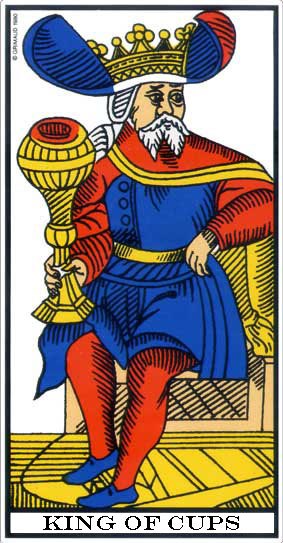
At first glance, it’s like the return to a primal Father and Mother. But then we notice in the blue of the King’s groin area the indication of female genitalia, whereas with the Queen, in the red area of her groin we see the indication of male genitalia. They express to us the Holy Androgyne. The Baton itself is male, yet Queen is female. The Cup itself is female, yet the King is male. He has fully integrated the feminine, she has fully integrated the masculine.
Going back the relation between this red form and the “wings” of the Empress’s throne—interesting. Instead of the lady sitting on the throne, the throne sits on her, rests on her lap. A reversal of the Emperor who leans against the throne. The King of Cups is very Emperor-esque.

She is giving birth to the living throne—it had to pass through her in order to be brought to life.
The bent knee vs straight leg…still represents a throne. A variation on the Emperor’s crossed legs. She is giving birth to someone sitting on the throne. Legs first, a breech baby.
She’s split in two…the standing and sitting versions. From the waist down. Unified vertically above. She is widwifing the split. The apron/rug is the part of herself that she is removing in order to make it independent.
The upper curve of the apron is like the book, the way her hands grasp it. Analogous to the High Priestess’s book. The amplified expression of an inner process. The book is what the High Priestess gives birth to. But only at her waist, not all the way down.
It appears as though the band around her upper waist is holding to parts together. As though her torso/arms would naturally be two different beings as well, held together by the band. It creates a kind of broom shape from the squeezing.
Is she scraping/popping the blue off of her with the baton? An implement she’s using?
We can also see it as her cooking, stirring the blue mass. Or beating the rug. But it could be like a pry bar, peeling it off.
Or squeezing the juice out of the baton. It’s not just broken apart, there is a flowing connectedness to it. Separating by virtue of the connection.
The left hand is clearly holding the blue. The right hand—unclear. Looks like it’s holding the baton.
It’s like a large knitting needle. Like Penelope—she could be weaving or unweaving the tapestry.
Have we been witnessing the weaving/knitting the whole time? In the blue of the Numbered Batons?


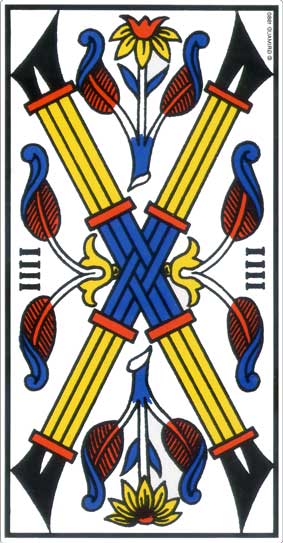


The baton(s) as knitting needle(s).
The timeline of Penelope—she only starts to weave when Odysseus is on Calypso, 10 years after he has left. She only starts then. Is it related to Odysseus’s backward and forward progress as he tries to get home?
The weaver of destiny. Direct, yet not direct. Dropping stitches, starting over.
The hair stitched/braided into the crown.
The crown is made of her hair. Elaborate hairstyle. The Golden Fleece. Rumplestiltskin, weaving straw into gold. The successful alchemical operation.
“If you arrive at gold, it doesn’t matter how you got there.” The Phillip Malone Maxim.
Or does it? Are we saying more or less “the ends justify the means?”
Not necessarily. It’s more nuanced than that. It’s more like: depending on the ends, they justify the means—and they’re never justified while one is still in the “means” part!
Ray Peat. The commodification of medical education interferes with the reality that each new idea modifies all of the old. What’s done is done, and yet—somehow the future reorganizes the past.
Not holding onto judgement. Take what is good and go forward.
It’s hard to know that acceptance while in the midst of the process, when one is not fully in integrity with the present. It can cripple the will, lead to fatalism.
Comparing the Queen of Batons to the others—they seem rigid and two dimensional, while she is full of raw harmony. Flames, water…full of movement.
When we look at the Knight of Batons sideways, we again see this Two of Coins symbol that can be found in both the Queen of Batons and the Magician.
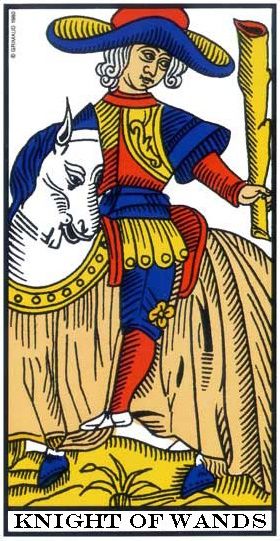
Why the Two?
In the Magician, it’s displaying what’s next on the table, that which is latent.
It’s like we’re seeing it’s activity in different realms. In the Knight, it is nearly vertical, and yellow. Then, in the Magician, it is still yellow, but now horizontal. In the Queen it is horizontal and blue.
The “tongue” of the Magician’s bag—never identifiable. Is it a bookmark? A ribbon? Doesn’t seem like a purposeful object.
A tea kettle with a flame? Cups laid out for tea?
In the tradiational Kabbalah (as opposed to Robert’s designations), the three “mother” letters are associated with the three horizontal paths of the Sephiroth Tree. Shin (Fire) is the path between the right and left side of the head. Aleph (Air) is the path between the right and left shoulders. Mem (Water) is the path between the right and left hips. The threefold human being, head, breast, metabolism.
The “Two” symbols seem to follow these. The Knight’s as Shin, the Magician’s as Aleph, the Queen’s as Men? But they’re lowered down somewhat. The Knight’s is below the head, the Magician’s is below the chest, and the Queen’s is at her feet.
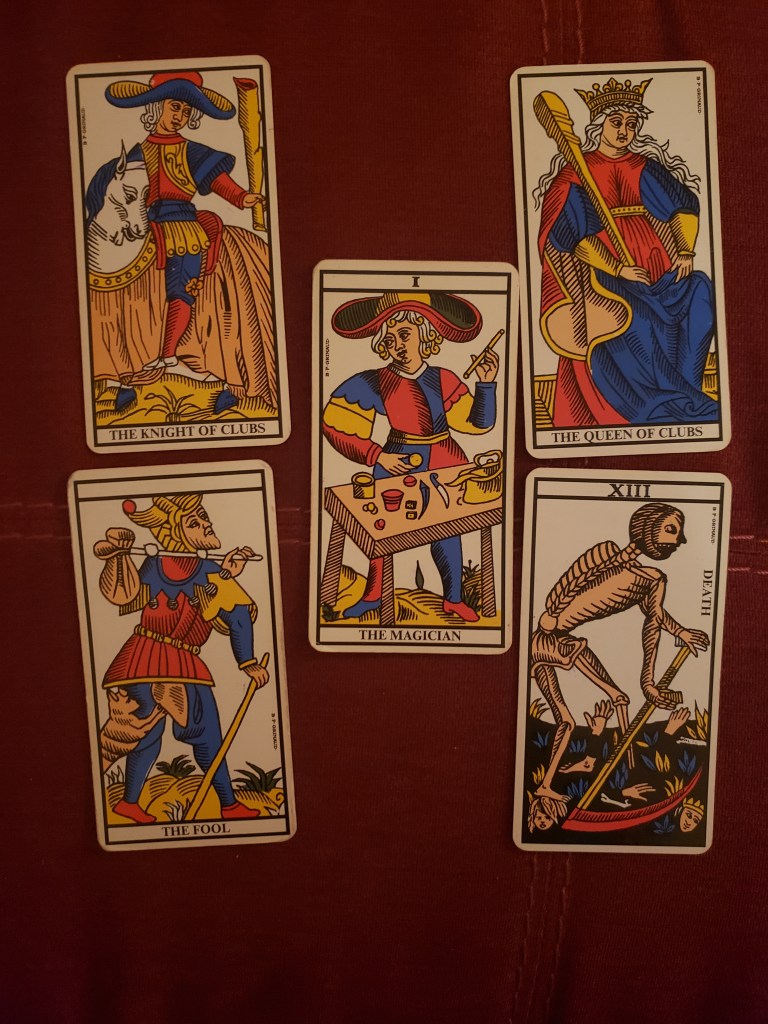
Somehow the Queen of Batons and Death do feel connected. The bare bones of death/mechanical forces is in contrast to the totally creative living process. Yet they share this gesture of cutting off a body below.
Death as the final resort. Things that should have been split. She’s splitting them at the proper time.
She bears eternal unity above—the spiritual domain—and below is the sensory world, which always presents itself in polarities.
The top of the baton is conspicuously unaddressed. Is it leaning on her shoulder? At rest? She’s looking away from it. Like the Queen of Coins.

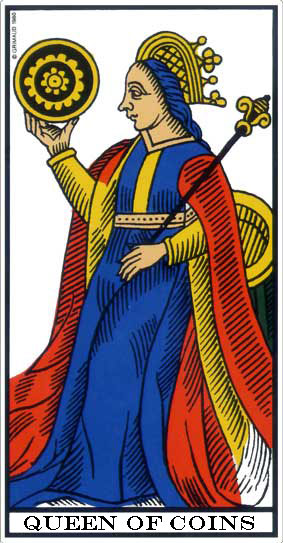
Not like the Knave or Knight—both of them look towards their batons. She is looking away from it even though it is close to her. Resonant with her head. Yet more linked where her hand touches.
She’s more akin to the King of Cups, who looks away from his cup.
The Empress and Emperor both look at the baton.
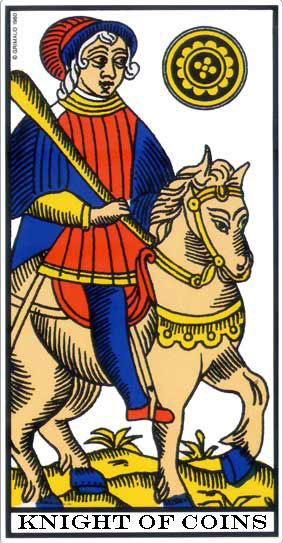
The Knight of Coins also has his baton relaxed, and he’s looking away. Resting it on his shoulder. But he is occupied by the coin. The Queen of Batons no longer needs the coin, she is even looking down a bit.
And hers is such a big baton. A massive club, a baseball bat. It would hurt if it hit someone.
With the Knave of Clubs, it’s like he’s just holding on a tree that’s growing in front of him. Unaltered other than the missing limbs. But hers is carved and shaped, with a sword-like split. Ornamental ridges, to do more damage?
Is the top mediating something to her? Collecting of what’s above? Or something coming from below and moving up? The arrows point upward. If a phallis, it would grow upward from below.
As object it’s finished, not coming into being, pulsing, enlarging.
Like the tool used to suction the nose of the baby at birth. The arrows indicate a sucking out of someting so it can remove itself, breathe, become its own.
Is it in place of her thumb? Similar to the Knight of Batons?
With the Empress—it is above downward, something incarnating.
Vs.
Below upward, removing something so that it can walk on.
A split below of the unified body above. But a unity of baton below that splits above. The head is the living human. The wood is what’s left of the undifferentiated after it becomes human. Still a very functional implement.
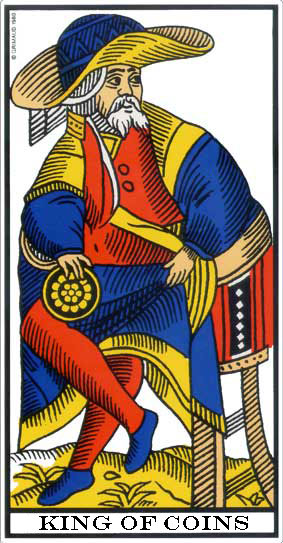
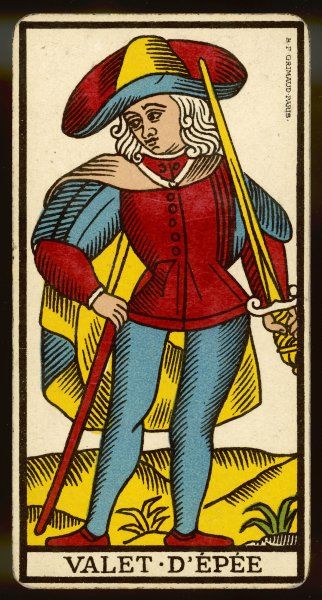
She is kingly—all Kings look away from their objects. The anomaly is the Knave of Swords, the Fish Man. But unlike the Queen of Batons and the Kings, he looks to his right rather than his left:

The Queen of Coins is Cosmic, the Queen of Cosmic archetypes. She is the Daughter in the Heights. The Queen of Swords is the sorrowful confronter of the double, operating in the human/social domain. Holy Soul in the Center. And the Queen of Cups is Cthonic, bound up with surging forces of earthly creation and destruction. Mother Nature in the Depths. The Queen of Batons bears all three of these in one. She is the summary:

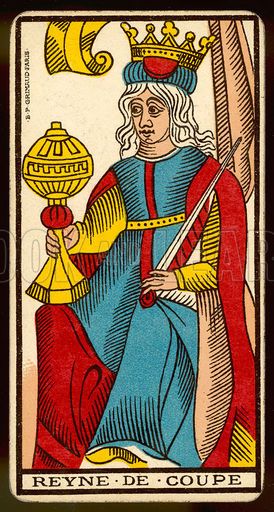
The Queen of Batons vs the Queen of Swords. They are equal opposites. Like sisters. One raised by witches, the other in the palace. Reminiscent of Lewis’s Till We Have Faces. Incredible parable of karma, the weaving of destiny.
Not knowing for center whether the means justify the ends until you get to the end. Can one have a transcendental sense of means that flow into the ends? The ideal can’t directly shine down into destiny in an unmodified way. It is always modified, bent light. Or can it happen?
Judith von Halle, the pure appearance of The Word in Christ. The primal Word of purity desecrated by fallen spirits. The theme of Das Wort—the sacrifice of The Word into sounds, so that they can become logoi, abundance. Wholeness leads to total disintegration. But then the resurrected wholeness is somehow greater than the original.
This can only be hope, we can’t have certainty. Things could go totally differently. The unlikelihood of it requires hope and will. Certainty would kill the will, lead to fatalism. Life circumstances of a certain intensity are required to shake the will out of fatalistic repose. Phillip’s life events—a picture of the results of a misguided/erroneous will. Flies in the face of figuring things out intellectually and making a different choice—it must be lived, passed through step by step as best as one is able.
The Queen of Batons transcends this.
What if the top of her Baton is a face? Looking down towards her? Maybe it’s responsive to her? Like a guard dog.
It seems to have two faces. Janus. A shadow face and a light face (Mimi Mond).
Her consultant. Both sides of a situation.
See it as two objects, a dark and a light. Perhaps they play a role in the overall bifurcation.
 The Unknown Friends