Notes of a Hermetic Conversation between Phillip and Joel on August 13, 2023.


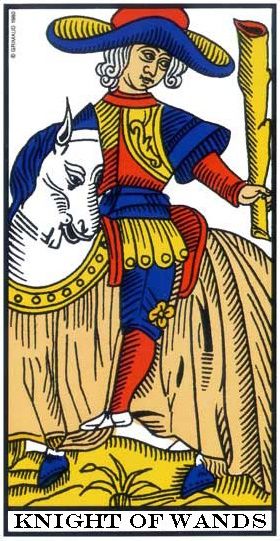

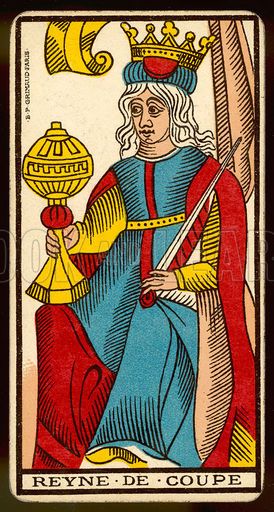
Why is her implement considered a Baton? It’s closed at the top. Like the Queen of Cups. It is open below? Is it pouring out the blue? OR just a different type of Baton? The Batons have a particular form from the Two through the Ten. The form the Baton takes in the Ace, Knave and Knight stands apart. The Queen’s, however, stands apart from both. A new form altogether.
It’s amazing that it remains preserved as a tree limb all the way through to the Knight and hasn’t been transformed fully into a club/baton by then. It isn’t the fully formed version of itself of until the end, until the Queen. This is unlike all the other Suits, which have their finished/functional form from the get-go. It’s not like we have some weird, primitive sword, even in the Ace.
The Sword and the Coin begin fully formed. But the Cup is almost the opposite—it begins too elaborate, too refined, too ornamented to really be a Cup.


Immediately after the Ace, the Cup simplifies. It doesn’t become overly ornamental again until the Queen and King of Cups.
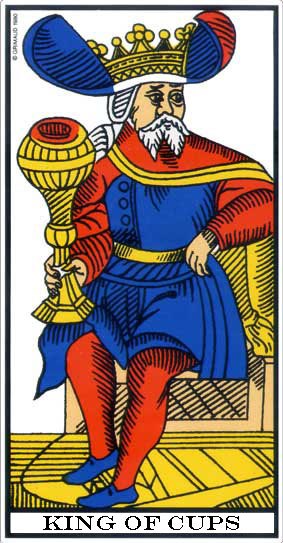
Whereas in the Suit of Batons, it’s only in the Queen (and, we presume, the King) that it is actually finished being made.
It makes sense—we see all stages of its creation. In a way, it’s like the Knave is the one who has just limbed the tree, cut the branch off. Or maybe not even, maybe he’s about to cut it out of the ground. Maybe it’s still growing there.
It reverses orientation from the Ace to the Knave (thick portion above then below). Then it reverses orientation again in the Knight, and changes from green to yellow/golden. Then in the Queen it changes form entirely.
A brute force instrument for a Queen!
Not a magic wand, or an implement of magical/biological/spiritual life, like the fire and sap as in the Ace.
There are two batons present in the Suit of Coins, but they are not like the Batons in the Batons.
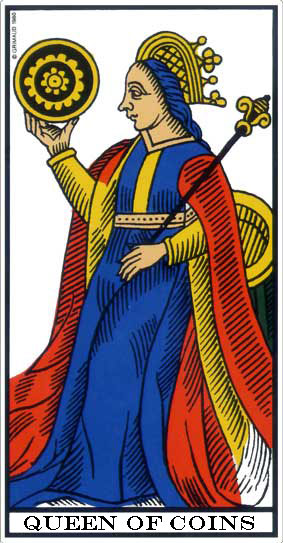

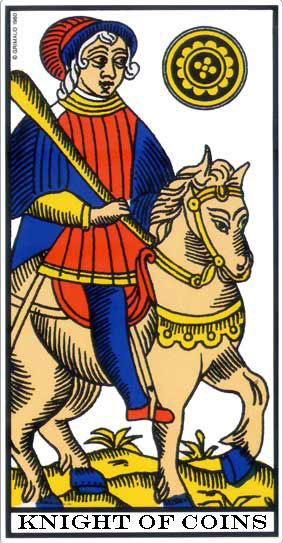
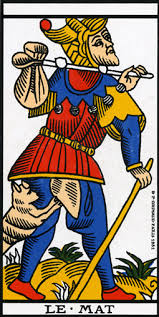
The Queen of Coins’ baton is like the Charioteer’s. And the Knight of Coins’ baton is like the staff of the Fool. These batons are just holdovers from the Majors, not images of what is to come.
But maybe here we’ve come full circle. Like the Suit of Batons are preparing the implements we will see in the Majors.
Seems backwards, to show at the end what came at the very beginning?
Not a summary of what you can do with all you’ve seen. Instead—here’s how it all arises, comes about.
We’ve imperceptibly moved from the end of the story to the very beginning.
Upon reflection—the story ended at the Ten of Batons, something hit its pinacle there. The Knave took us to this place before the beginning.
In the Suit of Swords, we were hypnotised. From the Ace through the Ten, or at least the Two through the Ten, we were caught in this pulsing repetition that was going nowhere. A pulsing tunnel, that seems to never end—then suddenly, we’re spit out the other end, in this trippy metamorphic domain. Softened, in stasis, made numb and malleable in order to be able to witness and participate in metamorphoses. Made receptive, then given what we were prepared for.
The Batons are different. The payoff in the Swords was after the Ten, in the Court Swords. Here the payoff, the “coasting” part of the ride was in the Nine and Ten of Batons. And now here in the Court Batons we are once again being prepared. These are not conclusive. They are a new softening.
The Numbered Batons are similarly bewildering to the Swords—but it’s not a meaningless vibration. There is a developmental culmination.
It’s surprising. We’re ready to see what really comes next—and no, we’re back to where the movie started. They already showed us the end.
With the Magician, we always had this mood of him being the preparation before the proper beginning (conception leading to birth), the prelude so to speak…but there is also this question, what preceded his activity? Where did he come from?
Well, this is where he comes from. The origin of the Magician is in the Court Batons.
It’s funny to imagine the “actual” beginning of the Tarot of Marseilles as the Knave of Batons, and the “actual” end as the Ten of Batons.
The Midnight Hour—the draught of forgetfulness. The totally organized plan of incarnation vs the picking up of the pieces to use in the descent through the planetary spheres, finding of a hereditary stream, etc, after the plan has been made. Climbing down Jacob’s Ladder.
This is one way we looked at the Minors—the Midnight Hour during the Numbered Coins, Saturn during the Court Coins. Jupiter during the Numbered Swords, Mars in the Court Swords. Sun in the Numbered Cups, Venus in the Court Cups. Numbered Batons were Mercury—the place in the descent where perhaps we feel as though we’ve acquired everything we need, everything we can get. Then the Court Batons as the Moon Sphere—getting ready for the plunge, for the moment of conception.
There’s a little bit of green on her—her left sleeve, between the blue and yellow.
Like a memory of the green baton from the Ace and Knave, but now horizontal. There is no green in the Knight.
“Set me as a seal, a ring on your arm…” – The Lover.
The more I look, the less I can formulate any question—she just is. Chaos and water flowing from one to the other, nothing rational about it. A literal depiction. Crown merging with hair. Sitting or standing? All these forms that take the space of her garb/being.
There is no sticking point, no “spiritual crisis”, no question. Except for the Baton itself. Why is it suddenly formed? So distinctive. Huge. Not religious or spiritual (as e.g. Emperor or Pope). An implement of War. Viking club. Very ancient, primal. But she is resting. Crowned—not a warrior. Giving it a softness.
It flows seamless through her hand into the blue of the gown. Is there a relationship? It’s odd—the lines continue a bit, but lead to watery puddles, flow, chaos. Is it a big spoon she’s stirring?An oar, is she rowing? Is it flat? Or cubish, with a rounded top?
If it is flat, it’s very oar-like. But it has a knob like a cudgel.
It’s out of proportion if there’s something on the other end. But if it’s flat, it could be a two sided oar. It could be the same on the other end. But then it’s no longer really a baton.
Whatever kind of implement it is—its effects seem related to the flowing.
Is it being poured out? Stirred? Is there a need to regulate what’s happening? Or create it?
Knitting needle.
There’s something reminiscent here to the Star or Temperance, especially in the blue. But she doesn’t have the implements they have. The Baton and her hands are holding the blue, there is no vessel out of which it pours. It’s pouring straight from her hand.
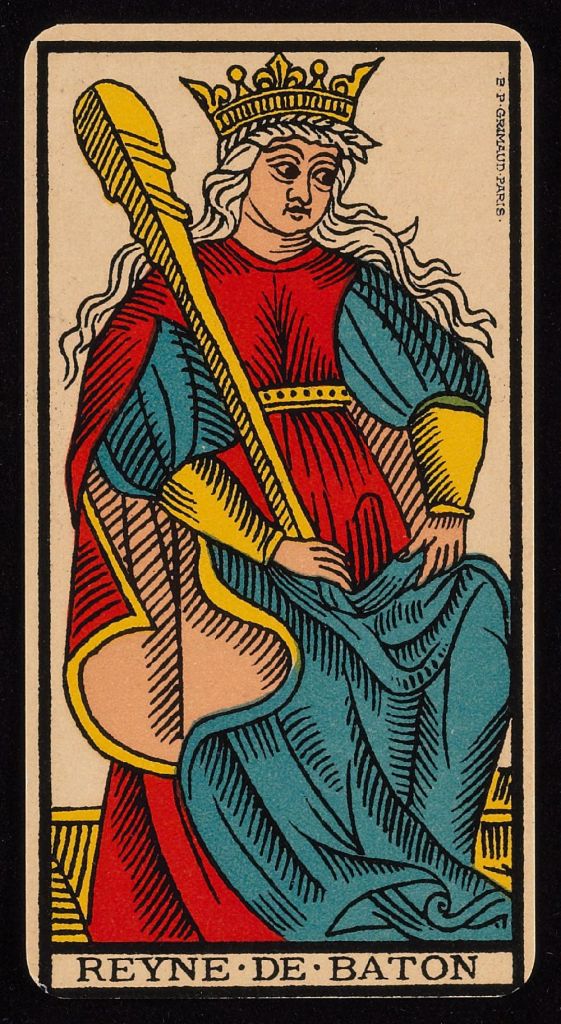


Joel realized something after the previous conversation, in regards to this connection between the Queen of Batons and the Two of Coins. The Two of Coin is the second Minor, and the Queen of Batons is the second to last. If we take the King of Swords and Ace of Cups as the midpoint, a kind of mirror point, we could think of the last four Minors as the personification of the first four Minors. Knave as personified Four of Coins.
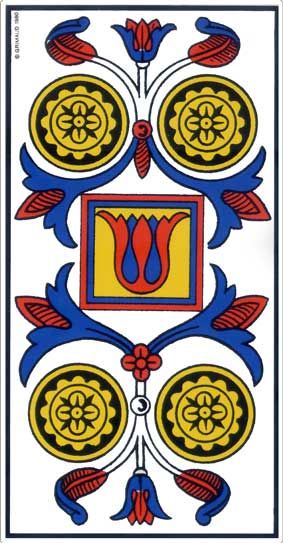


The Coins are metal, but what if they are also seeds. Like her implement. Tying into the waters. Disontinuous, yet they are interacting.
If a metal coin, how are they related to the plant growth around them? A similarly disjointed connection. A watery relationship, a flow between two apparently static elements.
Note—there is the green band on her sleeve where the blue meets the yellow. In the Two of Coins, there is a green band where the blue banner touches the golden coin.
The openings in the cloaks…entrance and exit.
Lazarus. The closing of the gates of hell. The Knave of Batons as the counter-image to the Four of Coins, the opening of the gates of hell. With the Four of Coins initially we felt—”How Beautiful! A prefiguring of what’s happening next!”—but why does it have this structured prefiguring of the Five of Coins? Whatever it is, it isn’t awesome.
After reading Judith von Halle’s account of the raising of Lazarus, which differs in key details from what Robert and Estelle Isaacson describe, Joel was looking into the legends around the Lazarus figure. In Estelle’s visions, and ACE, it is described how he was sent adrift on a boat with Magdalene and others a few years after the Resurrection, and landed in France, becoming the priest of Marseilles. But there are other legends around him, for example Russia also makes a claim on him. In the Russian legends, it is claimed that he never smiled again after what he had witnessed in the underworld. Resurrected, but broken. From a certain point of view—and especially if we keep in mind that this was Cain, and that perhaps he saw himself as owing the karmic debt to humanity that would require him to be the sacrificial lamb—although this sacrifice of total annihilation was taken on by Christ instead, Cain/Lazarus was nevertheless punished, took on some penance. Raised yet permanently broken by what he had gone through. Is that truly a reward, an act of grace? Or another version of the curse of Cain, to wander untouched and untouchable, in full consciousness of the darkness?
This individuality lives ahead of the times. Living in a world for which you are entirely broken, in fulfilment of a future condition (the mood and crisis and theme of the Four of Coins).
The Fall was an interruption by an alien element. Is the Reintegration similarly prefigured by an alien condition? Like when the attempt is made to resocialize a homeless person. They don’t know how to sleep in a bed usually, they have to sleep on the floor. Unaccustomed to the feeling of a mattress. The Tower of Babel, the loving Hand of God is felt as punishment by the impure soul until the time of purgation/purification is over.
Luciferic injection of desire at the Fall, compulsion. Inordinate degree of desire. Bolshevism, infected ideas leading to so much activity that it destroys the world.
Lazarus heals, his raising is an infusion that heals, but it breaks what is there. The original infusion of desire brings misery, a breaking of what was there. But then we adapted, the bone heals but heals incorrectly. To re-adapt, with the infusion of healing, is to first be broken again in order to set correctly.
The preview of the King of Batons:
Well, he sure is happy!
He’s holding a giant pen! Talk about a different style of Baton—we’ve gone from totally primitive club to advanced device. What do you even do with that? Draw in the sand? Inscribe into the flat ground right below him?
Crazy chair. Very flowy, and then suddenly straight/boxy. If the Emperor’s chair was looked at straight on, it might look like this—so it would look deceptively normal in profile.

He gives the impression of flying or floating in that chair, moving laterally. Is that blue fin under his right arm part of his outfit or the throne?
A modern art throne.
The King of Swords has a similar feel. He was like a sneak preview of the King of Batons. The King of Cups had this art deco floor.

But the King of Batons is over the top with every element.
That blue fringe…is it part of the shirt? Or the throne?
If a garment, it’s like that of a 1970’s, dancing robot a la Austin Powers or something. Or is it part of the throne? If so, why is it shaped like that? It’s not recognizable as part of the clothing or the throne.
Impression of a beetle, in the stomach region. Like the knees of the King of Swords. Or a more intense version of the Knave of Swords, the creatures in his torso.
He’s very harmonious and balanced for the amount of energy and uncertainty going on here.
There’s so much! We have to stop. A head rush. The build up doesn’t lead here! He’s like the Green Man, an all-powerful nature spirit—but it’s not natural at all. It’s very Man—the Future Man.
The large baton as a device for woodcarving? And these are woodcuts. He carved himself, and the implement for his carving. A paradox.
The homework assignment at the end of the Letter-Meditations on the Minor Arcana: “Carve thyself, and the too with which to do the carving.”
 The Unknown Friends